I think this makes version 3, for anyone keeping count, but I’ve redone the website once more - it’s now my workblog. Some of the new things to appear include the complete and highlighted portfolios, which are just up there in the navigation bar. There’s also an updated biography, for anyone wondering exactly who I am, and there’s also a picture, for anyone wondering what I look like sitting under a lemon tree.
So, no doubt things will be updated a little more regularly, seeing as I’m now able to talk about myself constantly, which makes things much easier.
Little Mathletics Mini-Interview: Sonic Preservation
6 Comments Published by alistairw August 17th, 2006 in Interviews
I must admit - I’m not particularly excited about any of the next-gen Sonic games. The PS3 and Xbox 360 game looks a bit crap, but then, I hated Sonic Heroes, so I would say that. I was kind of excited about Sonic Wildfire, but Sega have just changed the name to Sonic and the Secret Rings, which is a crap name and makes me not want to play it ever, despite the fact that it looks a bit like the cancelled Sonic Xtreme.
But I’m rambling.
The point is, there are other people who are looking forward to the new Sonic games even less than I am, though their reasoning is different, and, might I say, slightly more justified than “looks a bit crap” or “is a crap name”. Their main problem is the fact that, as you can probably tell from the above picture, the production company 4kids, who were previously just involved with the Sonic X cartoon, are now also voicing the games. Apparently, a lot of people consider them vastly inferior to the previous voice actors used, which is a question of taste, I guess.
Now, regular visitors here will recognise my disdain for fanboyism - especially message board fanboyism. I can’t stand people simply sitting around on their computers whinging about PS3 this, and Wii that. That’s what impressed me so much about the above picture, which was originally posted on Kotaku. People taking their fury to the streets! Like in the good old days! Admittedly, Alex Prins-Stairs, who put that and other posters up, does have a message board dedicated to the cause, but he describes it as just “where we fans are gathering”.
I asked him a few questions about the anti-4kids movement, and he sent me some very, very detailed responses, which was very cool. Because as much as I hate whinging, I dig passion.
Continue reading ‘Little Mathletics Mini-Interview: Sonic Preservation’
Little Mathletics Mini-interview: Tetris 1D
2 Comments Published by alistairw July 14th, 2006 in Interviews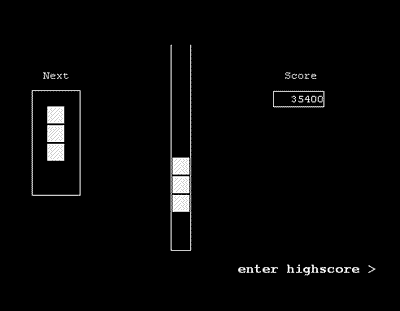
I spotted Tetris1D on Addicted Geek (who I really must stop stealing so many links from) a few days back, and proceeded to get all riled up about its misrepresentation of dimensional space. I realise it’s a joke, and all, but, nonetheless, here’s a quick interview with the game’s creator, zigah.
Isn’t the game, in fact, 2D, given that the pieces are technically made up of squares, which, by their very nature, have area? One dimensional space is normally just length or width - by giving your pieces both, you’re extending it a dimension.
In fact, even the smallest pixel on a computer screen is not infinitely small, and is a square or at least circle-like, so it is 2d.
Maybe you should consider the tetris1d squares as being a representation of infinitely small mathematical points, just zoomed a bit to make it easier on the human eye and to enable playing.
Without bending your mind a bit, you will never see the things hiding behind corners…
I get the feeling that I got pretty effectively shut down with the last sentence. “Stop being a pedantic bastard and enjoy the damn game” is, I believe, the message. Which is a pretty fair call.
By the way, twinoo, another game on zigah’s site, is well worth checking out. Described as “The First MoMPG (Mono MultiPlayer Game)”, it’s like playing Brain Training for both brain hemispheres at once.

If you were at all unconvinced about the amount of inventiveness in indie games, you’d do well to look at Hizoka T Ohkuba’s Warning Forever. Like bullet hell shmups, but don’t want to go through the drag of fighting your way through levels to get up to the bosses? This is the game for you. Much like Kenta Cho’s work, the graphics are understated vectors, with sprites used for explosions, and some of the weaponry, which gives the game a clean, stylised look that fits the stripped back nature of the gameplay - your ship only has one mode of fire, though this can be aimed in any direction.
The game features a number of modes - there’s the default 180 second mode, in which you lose 20 seconds for a death, but gain 30 for beating a boss; no lives, no continues, just a clock in the corner. There’s the three ship mode, in which you begin with three lives, and gain one for every 100 pieces blasted off the construction kit style bosses. There’s the five minute attack, which brings a certain kamikaze element into the game, or there’s its opposite - the sudden death mode, with just one ship. However, the genius lies in the enemies themselves. Each boss will learn from the movements and attacks of the player - if you attack the front of a boss, the next one will feature more defense there. If you die from a homing missile attack, the next boss will use more of these. It’s possible to mould the bosses to your will, but only to a degree - the positioning of the weaponry is, for the most part, randomised, so that almost every game is different. It’s thrilling, difficult, and more than a little bit awe inspiring.
Warning Forever first came out in 2001, but the final revision - version 1.7 - only came out last year. While we won’t be seeing any more improvments to this game, Hizoka has hinted at a new project on its way soon - Little Mathletics spoke to him via email (which was then translated) about this, Warning Forever and his passion for games. Continue reading ‘Hizoka T Ohkuba Interview’

When it was announced around the very end of March this year that there was a Bob Ross game in the works for PC, and Nintendo’s DS and Wii systems by an unknown developer, it was assumed to be an early April fools joke. After all, the gaming press and, indeed, the games industry itself is notorious for them. EGM’s Sheng Long prank of many years back not only led many readers to believe in the existence of a secret character within Street Fighter II, but many other magazines to publish it as confirmed fact. However, the confusion was quickly cleared up by AGFRAG Entertainment, the game’s developer, and by Bob Ross Inc., who manage the deceased artist’s estate - the game was very much real.
Bob Ross was the host of The Joy of Painting, which is estimated to be the most watched art show in US television history - one biography of Ross claims that at any given time in the US, Ross is finishing or starting a painting every half hour on a public TV station somewhere. Then show is still being shown regularly worldwide. Every episode, Ross would paint oil paintings in under half an hour, thanks to his (trademarked) Wet On Wet method of painting, in which the lighter colours are applied first, allowing one to paint directly over them with darker paint without waiting for them to dry. But it was his air of calmness and nurturing that drew in viewers, not his obvious mastery. “We don’t make mistakes here, we just have happy accidents. We want happy, happy paintings. If you want sad things,” he would say. “Watch the news. Everything is possible here. This is your little universe.” He believed everyone had a talent for art, and that it could be brought out through encouragement.
Ross died in 1995 of lymphoma, but his following continues. “We tell people sometimes: we’re like drug dealers. We come into town and get everybody absolutely addicted to painting. It doesn’t take much to get you addicted,” he once commented. His charisma is unmistakable.
In the past few weeks, AGFRAG has revealed that the game will be a Wii exclusive. They’ve also announced a competition, in which the six winners will have their Bob Ross style art printed on the box for the game, and they’ve started a Yahoo! group, through which fans can give feedback on various elements of the game.
Little Mathletics spoke to Joseph Hatcher, owner and director of development at AGFRAG about the game, and what it’s like being an independent developer for the Wii. Continue reading ‘Joseph Hatcher Interview’

Cristopher Boyer is the CEO of Variant Interactive, an independent developer and publisher based in Detroit who have recently made news on the games scene by picking up the rights to PC freeware title Doukustu Monogatari, better known to English audiences as Cave Story, a critically acclaimed action-adventure platform game. Gamer’s Quarter’s reviewer commented that the game reminded him of “why I play videogames in the first place”. In a time when the games industry is filled with clones, copies and ever extended franchises, it’s not hard to feel excited about what Variant and other independents are doing. Innovation is down, and the importance of profits is more noticeable to gamers than ever before. The ups and downs, successes and failures of any given title or console can be found on the majority of gaming websites. With independent companies like Garage Games taking Xbox Live Arcade by storm and attracting the attention of gamers, one gets the feeling that while the independent revolution of gaming may not be televised, but you’ll certainly read about it on Kotaku. Variant’s enthusiasm in particular is infectious. Their website states that their “mission and philosophy is simply to create the best environment for creative minds to produce the best games possible, upholding the simple truth that games, as art, can not be held hostage for outside concerns”. It’s hard to find fault with a company with a genuine passion for the industry it serves, and a site that shows its employees and management to be not only human, but also very funny.
Little Mathletics spoke to Cristopher via email about the upcoming E3, working as an indie in a big company’s industry, and why he does it. Continue reading ‘Cristopher Boyer Interview’

Speed runs - the act of getting through a game as quickly as possible - arguably date back to Gunpei Yokoi’s Metroid for the NES, back in 1986, which featured different endings based on the the time taken to finish it. While taking over 10 hours would show the main character, Samus Aran, with her back to the camera, apparently holding her hand up to her face in an expression of sadness, finishing the game in under one hour would show Samus in a bikini - albeit, an 8-bit one.
The first online speed running community was 1994, built around the Doom newsgroups and websites of the time. Later, the release of the Doom source code made it possible for players to slow the gameplay down, which lead to the branching off of the tool assisted speed run (or TAS) community.
With the popularity of emulators, tool assisted runs became possible on older consoles, eventually culminating in the release of Morimoto’s famous Super Mario Bros. 3 video, in which he finishes the game in 11 minutes and 11 seconds. However, the relative obscurity of the tool assisted scene lead to confusion about the video - was it real, or was it cheating?
Accusations of “fakeness” miss the point of the tool assisted scene. Even the idea of “cheating” misses the point. These speed runs are created for entertainment, for the sake of pushing the game to its very limits and seeing what can be achieved when the abilities of the player are enhanced. The runs are not achieved by cheating - the games are not hacked, and cheating is discouraged.
Joel Yliluoma, better known as Bisqwit, runs NESVideos, arguably the centrepiece of the TAS scene, and comments on the site that “instead of walking on the paths created for us, we create our own paths, our own legs and so on, and we’re not listening to people who say “you can’t do that!”.”
The result is often awe inspiring, and always entertaining, even for people not familiar with the game in question, because the runs are done with entertainment in mind. The guidelines on NESVideos suggest creating “art even while waiting”, and to “play for entertainment, not for ego”.
As for the Morimoto video, the time was beaten in 2005 by Genisto, who finished the game in 10:35.
Little Mathletics spoke to Joel via email about the site, the scene, and the criticism. Continue reading ‘Joel Yliluoma Interview’

Just to clear this up from the start, ABA Games is Kenta Cho - one man, working on games in his spare time. This, in itself is nothing new; there have been plenty of games made by one person - though not many of them have been this good.
Certainly not good enough to be called ” true artistry” by the Escapist, or the maker named “one of today’s best independent game programmers” by Macworld Magazine.
At its best, Kenta Cho’s work is another level above what is often put out by entire independent developers. For the most part, he’s focused on shoot ‘em ups - or “shmups” - a genre that started (arguably) with Space Invaders in 1978, and has evolved over the years through games like R-Type, Tempest, Xevious and Ikaruga. Cho’s work embraces the games that have shaped the genre, while adding to them and expanding upon them.
The controls of the games are rock solid, especially for those with USB gamepads, and the sounds and music are stunning. The graphics are often vector based (like those in Asteroids and Space Wars) but are detailed and beautifully animated - without exception. But perhaps the most striking thing about the games is the obvious amount of care and work put into them. That these games are not, for one, commercial releases, and secondly, not a full time project for Cho, is astounding. These games are amongst the best that the independent games scene has to offer.
Perhaps one of the reasons for this is that Cho doesn’t make these games for an audience. “I only created games that I want to play,” He says. “And shared them with people who want to play.”
These are games aimed at gamers - in this sense, they hark back to the independent scene of the 80s, when developers like Matthew Smith made games like Manic Miner and Jet Set Willy because that’s what they wanted to play. As we move into a time where game’s budgets are moving well into the tens of millions, it’s heartening to see this spirit hasn’t died out.
Little Mathletics spoke to Kenta Cho via email about the history of ABA Games, the inspirations behind his work, and what’s still to come. Continue reading ‘Kenta Cho Interview’

Beginning in 2001, GarageGames have aimed to bring games development back to the independents - or even the individuals. Founded by Jeff Tunnell, Rick Overman, Tim Gift and Mark Frohnmayer - all formerly of Dynamix, which was closed by Sierra during the restructuring of the company by Vivendi Universal.
GarageGames is there to take the focus of the industry away from the big publishers like EA, and inject creativity and freshness into a market that has become bogged down in sequels and licences.
The company’s website is not just a place for the companies products to be sold, but is a support network and research centre for developers, who can use the considerable expertise of those who work there.
The main product is the Torque Engine - a modified version of the engine used by Dynamix for Tribes 2. And immensley powerful piece of software, it is available to indie developers for US$100, and has recently been expanded to include the Torque Shader Engine, which allows support of higher level shading technology.
The Shader Engine was used to delevop Marble Blast Ultra, which was released onto Xbox 360’s Live arcade to enourmous success, effectively raising the bar of what was thought possible by an indie developer.
We spoke with Jay Moore, self described Evangelist, buzz builder, biz dev. guy, and game promoter from GarageGames. Continue reading ‘Jay Moore Interview’

The first issue of Bear hit the stands in June of 2003, and the tenth and final issue arrived in December, 2005. In between, Jamie Smart estimates that he worked on 300 pages - half of which were collected in 2004’s Bear: Immortal trade paperback, the other half of which will be collected in the upcoming Bear: Demons in June.
The comic is published by Slave Labor Graphics, an American “alternative” company, though Jamie himself is British.
Past articles on Little Mathletics would suggest that this is the point that I should start talking about how the work is an example of postmodern genius, but Wikipedia beat me to the punch:
“The stories are marked by a combination of violent shocks, random silliness , and other hallmarks of Dada.”
I could spend a while here arguing that it does not, in fact, show the hallmarks of Dada, but that would be missing the point of Bear. It’s short, sharp and hilariously funny, and for that reason, it appeals to a wider audience than a majority of comics. Storywise, Bear is simply the story of a stuffed bear, named Bear, his owner, Karl, and Looshkin, Karl’s cat, whose life’s work is to torment and maim Bear. There’s no story arcs, or alternate universes, just swearing and destruction. And faeces. It’s got something for everyone.
Little Mathletics spoke to Jamie Smart about Bear, his new projects, and much, more more. Continue reading ‘Jamie Smart Interview’
Search Blog |
Categories
|
Latest Posts
|
||