Yu-Chen Shih Interview
Published by alistairw February 10th, 2006 in Interviews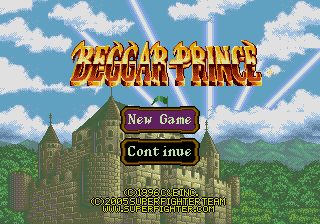
Whilst talking to Brandon Cobb, president of Super Fighter Team, Little Mathletics was lucky enough to be given the chance to conduct an exclusive interview with Yu-Chen Shih, the lead translator on Beggar Prince.
How did you find out about the Beggar Prince project?
My first encounter with this project was on a site called Whirlpool asking for a Chinese translator. The person asking for a translator, whose name I have no permission to declare, contacted me and I became his translator for Beggar Prince. At the time, however, there was no script for me to translate yet. He then contacted Brandon for help because he did not have enough computer skill to complete the project. Later, Brandon got the contract with C&E for the game and took over the project. I basically just continued being the script translator for the game.
How accurate did you aim to be with the translation?
I generally tend to translate as literal as possible, or else the closest meaning I can translate to for the phrase. Brandon Cobb edited the script to make some parts more interesting because the original may have not been dramatic enough.
How did you go about changing references that could be considered too culturally specific?
The biggest challenge culture wise would be how names were created in Chinese versus English. In Chinese,
person and place names can be created from combining words that makes sense, even though there may be no
such word that would fit well in English.
For example, Mt. Tiger Head, or Tiger Head Mountain, in the original text it has these three Chinese characters with the following meanings: Tiger, Head, and Mountain. Of course, for literal translation we can just use these words together, but if someone wants to use only one word to translate that, it would not be easy since there is no english word meaning “tiger head”.
As for Chinese idioms and such, there may have been some, but not a lot. Also, the game’s background setting is in a fantasy middle age type world, so there are not many culture related problems regarding dialogs. The only thing I can think of would be how the original text called the king “the Chinese way” by using the two characters meaning ten thousand years of age, meaning the king will live that long, instead of saying long live the king.
How much of your time is invested in a project like this?
The total time it took for the translation from start to finish may have been 1.5 to 2 years. The actual time (not counting slack time, which is my normal life) would be 1-2 months. Of course, it is possible to finish it in less than 2-3 weeks (without editing), but rushing would mean possible mistakes and it would be overdose for a freelance translator.
I’m only a freelance translator, which means I’m not doing this as a job. It is not my area of study either, it’s just that Chinese is my native language and English was the language I had to learn and know to live in Canada.