Fred Basset
Published by alistairw February 22nd, 2006 in Articles
This piece was originally published in zine form as “Fred Basset: A Postmodernist Reading of the Work of Alex Graham” for the 2006 Adelaide Fringe Festival Zine Fair. Since then, mostly nothing has been changed, which might lead some purchasers of said zine to feel somewhat cheated out of their 20 cents.
Scottish illustrator Alex Graham, born 1917, began selling comics to various magazines during World War II, which, amongst other things, seems to suggest that he didn’t actually make it to the war. His cartoons still proved inexplicably popular, with Wee Hughie , which started in 1945, being presented in Dundee’s Weekly News for 25 years.
Two other comics that debuted in 1946, Our Bill and Briggs the Butler also found success. Finally, in 1963, inspired by his own basset hound, Frieda, Graham, who was, by this time, 46, began working on what would become his best know project… Fred Basset . The comic appeared in London’s Daily Mail for the first time on Monday, July 8th , 1963, where it immediately found an enormous, and once again, inexplicable, popularity.
Graham died in 1991, but had mass-produced enough of the strip to keep it running for another 18 months, after which they started the whole damn thing over again, and will probably continue to do so until the end of time itself.
Fred Basset , quite simply, is not a popular comic. Even the most glowing of reviews, by fan Don Markstein reads:
“The jokes in Fred Basset aren’t the least bit topical. They’d be understood and enjoyed almost anywhere in the world, generation after generation.”
Damning with faint praise? But that’s nothing compared to the abject savagery of “Yooper” on the WebComicList page for Fred Basset :
“Does ANYBODY find this strip the least bit humorous?”
And Alex Graham turns over in his grave. Even Wikipedia comments that the comic features:
“[Fred Basset] in a number of situations that many find to be more matter-of-fact than humorous.”
The question is, is it that simple? Is Fred Basset truly just not funny at all? Or is it in fact something deeper than that?
Could it be that a populist work can be enjoyed by the majority, but truly appreciated by a minority?
Is Fred Basset more than just the work of a middle aged man with nothing better to write about than his dog? Is it a work of a postmodernist genius?
To answer that, let’s look at the work of postmodern commentator Dr. Mary Klages, Associate Professor, English Department, University of Colorado , Boulder . She offers an overview of postmodernist thought filtered through a comparison of seven rules, or guidelines, of modernist thought.
The main difference between modernist and postmodernist thought, she says, is that postmodernism is a celebration of everything that modernism considered a tragedy. Where in modernist literature fragmentation, for example, was the representation of melancholy or loss the postmodernist writer says, well, the world is strange and incoherent. “Let’s not pretend that art can make meaning then,” Says Dr. Klages. ”Let’s just play with nonsense.”
With the idea in mind that postmodernism celebrates what we are about to discuss, let’s now look at Dr. Klages’ seven guidelines of modernity and how they relate to Graham’s work in Fred Basset and why the text doesn’t just use these structures; it embraces them.
Guideline #1
An emphasis on impressionism and subjectivity in writing (and in visual arts as well); an emphasis on HOW seeing (or reading or perception itself) takes place, rather than on WHAT is perceived. An example of this would be stream-of-consciousness writing.
One could hardly claim that Graham’s work is stream-of-consciousness, but there is certainly some suggestion in his work that the element of the fact that the comic itself is there is more important than the actual content of the work.
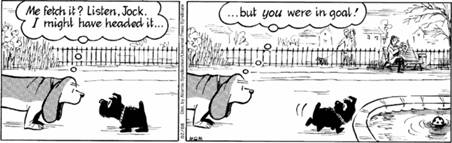
Take, for example, the piece above, in which Fred’s friend Jock has missed the ball, which is now in a pond. The piece itself is uninteresting, and lacks a conventional punchline – but still the comic exists, and still the reader absorbs the content. Is that not, in you, as the reader, reading it and not enjoying it, an admittance of form over content?
Guideline #2
A movement away from the apparent objectivity provided by omniscient third-person narrators, fixed narrative points of view, and clear-cut moral positions. Faulkner’s multiply-narrated stories are an example of this aspect of modernism.
A multi-faceted guideline; in my opinion, one must decide whether the work is restricted to single narrative form or not, and then focus on whether the work contains a simple moral position.
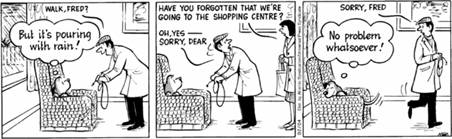
Let’s take the above piece as an example of the narrative functions of Fred Basset . One could argue that the narrative is often carried out by the titular hound, but this is not always the case, as shown above. While Fred arguably carries the narrative through the first and last panels of the comic, the female character advances the story in the second panel – certainly a case of multiple narrations.
The moral position of Fred Basset is often unclear. Is the male owner in the wrong for having suggested to Fred that they take a walk in the rain? Or is the female character in the wrong for having stopped the exercising of the dog? Or, indeed, is Fred in the wrong for disagreeing with the idea of the walk in the first place? The comic is unclear on this matter, suggesting that there is, in fact, no clear cut moral position.
Guideline #3
A blurring of distinctions between genres, so that poetry seems more documentary (as in T.S. Eliot or E.E. Cummings) and prose seems more poetic (as in Woolf or Joyce).
Certainly, this is one of the easier of Dr. Klages’ points to argue. Comic strips, in their very nature, and as is suggested by their very name, should be comedic. However, Fred Basset does seem more “documentary” than comedy – remember the quote from Wikipedia?
“…more matter-of-fact than humorous.”
Or Yooper, who asked whether anyone found Graham’s work humorous? Fred Basset blurs the lines between comedy and documentary in its very origins; Graham, the man so interested in his dog that he scripted literally thousands of comic strips on what many would consider a prosaic topic. More importantly, it blurs the lines by simply not being funny, at all.
Guideline #4
An emphasis on fragmented forms, discontinuous narratives, and random-seeming collages of different materials.
Graham’s work, it is often suggested, lacks a punchline, or, in the eyes of some, a final panel. This would certainly fit into the category of a discontinuous narrative. Taken as a collection, that is, in one of the over 50 published books of Graham’s work, it must seem fragmented. I admit that I’ve not had a chance to investigate these books, but the comic rarely – if ever, in my experience – features a follow-on storyline, unlike other comics like Garfield often does, or Zits , for example.
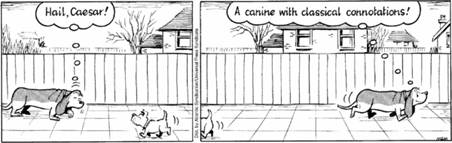
The above piece features what is known as the “set-up” for a joke – Fred’s comment on the “classical connotations” of the smaller dog’s name – but fails to capitalise on this. Alternatively, if this is intended to be the punchline, the characterisation is far too vague for it to make sense. Why is it funny that the smaller dog’s name is that of a Roman empire ?
If it is the case that the piece is complete and the punchline intact, then the characterisation is too fragmented for it to make sense, and the piece too random, in the context of Graham’s work as a whole, for a comedic effect.
Guideline #5
A tendency toward reflexivity, or self-consciousness, about the production of the work of art, so that each piece calls attention to its own status as a production, as something constructed and consumed in particular ways.
As odd as it may seem to those unfamiliar with the work of Alex Graham, he was, in fact, quite renowned for breaking the fourth wall. The fourth wall is a concept that comes from the idea of the Proscenium Arch style of theatre, where the stage itself would often feature the three walls of a set, thus the fourth wall would be open to the audience. To “break” the fourth wall was to speak to the audience, as if ignoring the existence of the invisible wall.
It is quite reasonable to argue that doing this constitutes a case of subjectivity in the written and visual form as discussed in point one; that it emphasises the act of perception over the content that is perceived.
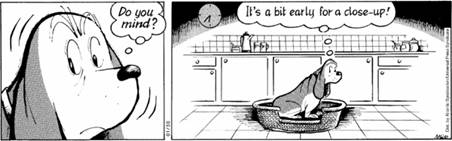
The above piece not only breaks the fourth wall, but self-consciously draws attention to its status as a comic strip.
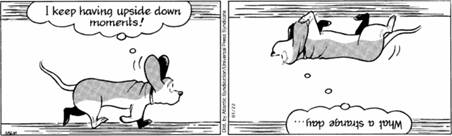
This piece doesn’t necessarily break the fourth wall - although some would argue that the very narrative of a character that cannot be heard by the two other main participants constitutes breaking the fourth wall – but it does, again, draw attention to its comic strip status. It’s also a very good example of fragmentation and discontinuous narrative, and of the majority of the points discussed above – it could very well be Graham’s masterpiece, in terms of postmodernist expression.
Guideline #6
A rejection of elaborate formal aesthetics in favor of minimalist designs (as in the poetry of William Carlos Williams) and a rejection, in large part, of formal aesthetic theories, in favor of spontaneity and discovery in creation.
This is possibly the most subjective of Dr Klages’ points, especially when used in relation to comic strips. It can be suggested that the aesthetics of Fred Basset are indeed minimalist when compared to the hyper-realistic artwork of other newspaper based comic strips like The Phantom or Spiderman . In terms of comic strips, these two, and, in particular, the long running Phantom represent the furthest the genre has gone in terms of a formal aesthetic theory – look, for example, at the detail in every panel of The Phantom .
I would suggest that Graham’s work fits in with this point simply by fitting in with the other of Dr Klages’ guidelines, which, in themselves, represent a rejection of a formal theory and an embracement of discovery in creation.
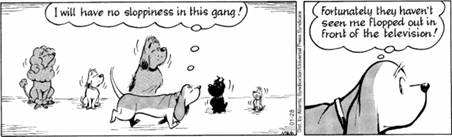
To focus purely on aesthetics again, the above piece is undoubtedly minimalist. The setting itself is entirely unclear, and while the actual breeds of the other dogs is clear enough, the lack of individual characterisation suggests a rejection of formal aesthetic theory, that is, a rejection of the very idea that each character must be an individual in the first place.
Guideline #7
A rejection of the distinction between “high” and “low” or popular culture, both in choice of materials used to produce art and in methods of displaying, distributing, and consuming art.
This is easily proven without the use of an example; the fact that Graham’s work, despite its apparent complexity, is found distributed through tabloid format papers like the Daily Mail , Melbourne ’s Herald Sun and Adelaide ’s The Advertiser represents a rejection of high and low culture stereotypes.
On another level, this could also be seen as an example of Jean Baudrillard’s theory of simulacra – the idea that, in a postmodernist society there is no “original” work of heighten monetary or intrinsic artistic value. Think, for example, of the mp3 format – if a song is popular, and millions of copies are sold, there is no one mp3 that is worth more than any other; they are all just copies of one another. This is also true of Alex Graham’s Fred Basset ; by using newspapers as a method of distribution, no one strip is worth more than any other. In fact, the repetition of his work after his death only further enforces this point – it is the work itself that has value, not the physical representation of the work.
Indeed, the format of Graham’s work – a comic strip, as opposed to a book, or a painting – represents a rejection of low/high culture stereotypes better than anything else. What better way than a comic strip, regarded for years - arguably until the work of Frank Miller, et al, came about in the 80s – as the lowest of all low culture forms to present a masterwork in postmodernism?
Fred Basset and Postmodern Politics
Finally, let’s now look at Dr. Klages’ theories on the relationship between postmodernism and politics and how this relates to Graham’s work. “Postmodernism seems to offer some alternatives to joining the global culture of consumption,” She says. “Where commodities and forms of knowledge are offered by forces far beyond any individual’s control.”
In other words, “Postmodernist politics offers a way to theorize local situations as fluid and unpredictable, though influenced by global trends. Hence the motto for postmodern politics might well be ‘think globally, act locally’-and don’t worry about any grand scheme or master plan.”
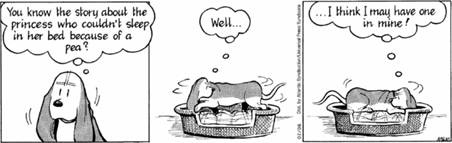
The above comic is as good an example of this as any of Graham’s other pieces – the entirety of Fred Basset is an obsession with the individual, in this case, as with most others in the text, it is the titular character presented as the individual. Fred Basset is, in many respects, a celebration of the everyday (or, as Wikipedia put it, “the matter-of-fact”) rather than a topical representation of the outside world.
The obsessions of the characters with their own problems – the ball in the pond, the lump in the bed, the rain outside, or the spousal obligations, to name just a few – signify an almost gleeful ignorance of the world that goes on around them. This is made even clearer by the fact that what appears in the newspapers these days is a repeat of what has already appeared. Though the outside world may have changed in innumerable ways since the text’s debut in 1963, the cares and beliefs of Fred and his co-stars have not.
In this sense, the comic strip is an embracement of post-modernist politics through its complete lack of political influence and utter ignorance of events on a global scale. The self-obsessive nature of its characters sets the strip up as a satire of its own self-obsession, and the genius of it is is that it only becomes more satirical as time goes on - by the time its second rerun comes around, over 60 years will have passed since its debut.
So, Yooper, and all you other Fred haters, you can sledge Fred Basset if you will, but the work of Alex Graham is demonstrably deeper in postmodernist thought and theory than any other comic strip in any other newspaper you would care to name.
I have always considered Fred Basset to be an expression of Camus’ notion of sisyphean existential angst, in that the process of reading it is invariably not only mundane but incredibly repetitious and painful. In both form and content (or lack thereof) Basset inspires in the reader a sense of the pointlessness of existance and the futility of expression, belief and life itself. What format more than the daily newspaper represents the futility and repetitiousness of life in a bourgeoise society? Graham communicates with us through our own anomie and self loathing, his canvas is our sense of mortality, his message is a constant reminder of our impending deaths.
One day more. Dad brought home “El Norte de Castilla”. Bad news once again, these pictures of well-groomed cats :-?…
-and Fred Basset.
This day it might be different. It may stir your thoughts. You read it.
Well that day wasn’t different. On to the TV schedule.
The newspapers from Madrid had these editorial cartoons, these comic strips that…
The lure of Madrid, so far away from my backwater town. Madrid was a place where even the newspapers, so laden with bad news, had a place for something different. They had a place for a smile.
I admit that Fred Basset isn’t the funniest comic ever written but it definetly isn’t the worse either.
Infact i really only started reading it when the local radio station started the Fred Basset segmant.
I enjoy the way they read it, they bring out the humour in the comic.
To me Fred Basset is a constant reminder of how silly and sometimes even meaningless our little lives are…and that’s why I find the comic so funny!
felicidades me gusta mucho la comiquita de basset yo tengo un basset y son exactos
fred basset is very funniest i like so much i have one basset and the personality is similar.they are person .they don`t now the are dog
Having rewritten the Wikipedia entry over the last few months as it was hopeless & just lowbrow insults, yes we love Fred Basset. We know the jokes get repeated & can be a bit pointless, but Fred has a charm & we admit to thinking rather like Fred too. —- Pity the new Freds by Michael Martin… NO THEY ARE NOT OLD ONES REPEATED shows who actually reads em.. pity they’re so hurriedly drawn to lose the character & expression of peak years Fred. —- We love FELIX THE CAT too, another cartoon character with personality THE FIRST ONE! Garfield & his ilk don’t have much personality really, Fred has many dimensions, Felix was always after a feed & liked to help people out. But that’s Felix 1919-1930 only, after that he loses it. Fred’s stayed on form for 44 years! The 2006 strips are still enjoyable if the drawing a bit off. GERRAHTAVIT as Fred’s master would say, if you disagree! :o)
Don’t be dissin Fred.
To whom it may concern, i am quiet the Fred Basset fan if i do say so myself. I belive his pun with words is quite ingenuis and have come to the conclusion that it is halarious! I would be most delighted if i myself, Fred B Lenald, could somehow obtain such comical, comics. i would like it very much if you good sir (possabley madam if you will) would allow me to put them on my myspace.
Cherrio Fred B Lenald
P.S this isn’t my email it was my sons but the youngster hadn’t any use for it so i seased the opotunity to grap such a deal.
Cherrio once again fine sir (possabley madam if you will) Fred B Lenald
To whom it may concern,
If I may say so, I am quite the Fred Basset fan. I believe his puns are quite ingenious, and have come to the conclusion that the comic strip is hilarious! I would be most delighted if I, Fred B. Lenald, could obtain these humorous comic strips. I would like it very much if you Sir (or Madam, if you will) would allow me to put them on my myspace.
Cheerio,
Fred B. Lenald
P.S This isn’t my email it was my son’s but the youngster hasn’t any use for it so i seized the opportunity to use it.