The Little Mathletics Shipping Report (23-29 September)
Published by alistairw September 29th, 2007 in Shipping ReportOh, hello there. It’s been brought to my attention that I am, in fact, a very lousy blogger, and can’t even keep up with blogging about what I’m doing for work. This, I admit, is very true. I am a horrible blogger. So, in order to try and work around that a little, I’m starting this new column/regular occurrence: the weekly Little Mathletics Shipping Report. In this regular feature, I’ll be talking about, basically, what I’ve been up to for the week; what I’ve been listening to, reading, watching, playing, and so forth.
It should be up every week around this time, barring massive life affecting issues, ie. general weekend lethargy and blatant laziness.
So, come with us now upon the good ship Littlemaths, as we take a gander at this weeks Little Mathletics Shipping Report. You’ll have to excuse the fact that this is, in fact, a very big block of text right on the front page, but I don’t seem to be able to post breaks, as it gives me a 404 error. For the same reason, you can’t post comments at the moment. If anyone’s got any ideas as to what might be causing this little problem, get in touch! I’m confused and a little frustrated.
———————
I’ve been watching a lot of YouTube stuff this week. The first thing that caught my eye was Jonathan Ross’ amazing BBC 4 documentary on Steve Ditko, co-creator of Spider-Man and Dr. Strange for Marvel. Dtiko’s work on those two titles is incredible - Ross, in an article for the Guardian, notes that his characters have a sense of “grace and poise and finesse rather than brutal strength and power”. His hands, in particular, are unmatched. Check out some of the early Spider-Man, because his posing when Spider-Man is shooting webs is just fantastic; the hands are so full of life, and Spidey’s movement through New York’s skyline is just brilliantly fluid. His work on Dr. Strange is just as expressive, but it’s the visions of other dimensions that earned the title its band of followers in the late ’60s - it’s supreme psychedelia of the highest and most creative order.
Ditko left Marvel after only 38 issues of Spider-Man in 1967, and went to work for Charlton, a small publishing house where he’d got his start years earlier. The reason, or rather, reasons, he left are often what confuses people: why would an artist and plotter on one of the most successful books just up and leave? 38 issues might seem like a long time now, but consider, for example, Jack Kirby’s 100 plus issues on Fantastic Four. Ditko’s move was seen as pretty strange (no pun intended). But the reasons are pretty reasonable: he was unfulfilled morally by the Marvel work, and resented Stan Lee’s liberal inserts into his storylines when Lee would script them, and he was concerned about the treatment of major artists at Marvel as well. Kirby himself would leave for DC for that very reason two years later.
While at Charlton he created, amongst other characters, The Question, an objectivist vigilante who punished those who stepped onto the side of wrong. He followed this up the same year with Mr. A in the alternative book Witzend, which took his Randian philsophies to an even more extreme level. As the splash page for one issue said:
“Make your choice! No one can do it for you! You uphold the good or you join the evil! It’s either one…or the other!”
It’s heady stuff, and it put off a lot of Ditko’s fans who, at the time, were fairly liberal late teens. Ditko later went on to work for DC, where he created The Creeper, and The Hawk and The Dove (a fairly stinging attack on liberality and the inaction that Ditko associated with it), and eventually returned to Marvel for a time in 1979. From there, he freelanced his work to various companies, though he never really worked on anything as high profile as Spider-Man. According to various people working with him at the time, however, this was more a case of personal choice rather than anything else; attempts to even get him to feature Spider-Man or Dr. Strange in cameo parts in Marvel comics he was pencilling would inevitably just end in a polite declination.
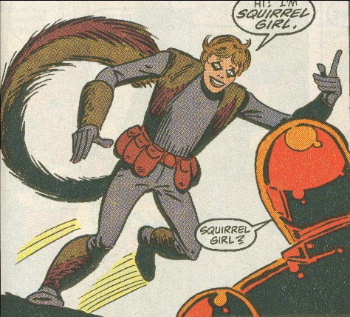 Actually, there was one more important character that wasn’t mentioned in Ross’ documentary: Squirrel Girl, who’s one of my personal favourites. Ditko plotted the story she was featured in - an issue of Marvel Super Heroes in 1992, and pulp writer Will Murray scripted it. In it, Iron Man meets an up and coming super hero named Squirrel Girl who…uh…has the ability to control squirrels. She then goes on to defeat Dr. Doom. Classic stuff. She’s been written better since then - Great Lakes Initiative/Deadpool Summer Fun from a few months back was absolutely brilliant - and she’s hardly a typical Ditko character, but still.
Anyway, Ditko is probably most notable these days for what most people perceive as some kind of hermitic behaviour. There’s no more than four photographs of him in the public space, and only one known voice recording of him. He hasn’t done an interview since 1965, although he has written pieces for The Comics fanzine. It’s not that he’s a hermit, though - he’s just an intensely private person who believes in letting his work speak for him, which is understandable.
That brings us to the point of Ross’ documentary, then: he essentially went off in search of Ditko, while trying to tell the Ditko story along the way, speaking to John Romita Sr., Neil Gaiman, Joe Quesada, Ralph Macchio, Alan Moore, Mark Millar, Stan Lee and others to get their views and input. He does meet Ditko, in the end (taking Gaiman along with him as his “sidekick”) simply by going and knocking on the door of his office, though Ditko, predictably, declines to be interviewed or photographed. What makes the documentary so fantastic, however, is Ross’ own passion for the subject - he’s a self-admitted Ditko fanboy, and it shows in the fevour with which he brings the story together.
It’s easy to recommend this, but unfortunately it seems to have been taken down from YouTube. I gather it might appear on some kind of BBC online service sometime soon, and will no doubt get a commercial release of some sort. If you’ve got any interest in comics, it’s worth keeping an eye out for it, and if I hear anything, or see it around again, I’ll make sure to post it.
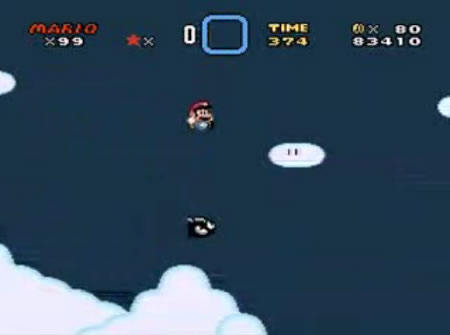 I’ve been watching a lot of Kaizo Mario as well. Literally, the name is “Making my friend play through my own Mario hack”, but it seems to be shortened to simply Kaizo (hack) most of the time. Or, as the YouTube video lists it: Asshole Mario. Which is very appropriate, really. This isn’t your average Super Mario World hack (by which I guess I mean they haven’t swapped out the Mario sprite for a KKK member or a Nazi). I think they’re made by R. Kiba, though I have very little knowledge of Japanese so I’m probably wrong.
It is quite possibly the most fiendishly put together set of levels I’ve come across - there’s only one way to get through these levels, and the timing and problem solving involved in playing through them is simply astounding. And the patience. Hoo boy. Just watching it makes me twitchy at times. There are moments you just have to laugh, when, after completing an intensely difficult section, the player (whose name, I believe, is T. Takemoto) will die because there was an invisible coin block just at the angle he was trying to jump. It’s devious, and must have been frustrating as hell for the guy playing through it. I probably would have thrown my controller across the room, and I’m not the sort to do that at all.
Like I said, though, it’s actually pretty funny, mostly because it is so devious. There’s a real humour in the ridiculousness of the level design - these are levels that I wouldn’t even attempt, and I like to think I’m at least reasonably good at SMW. It’s achievable, though, even without doing a tool assisted run, and that’s a big part of the appeal of these videos, I think: the player is fallible, and screws up even the most simple things some times. And he dies a lot. There are some levels, according to the end sequence, where he dies well over 100 times.
Actually, the editing on these videos is really great - it shows a lot of unsuccessful attempts, but it keeps the action moving forward too. There’s also a number of times that just show death after death for a few seconds. It’s really well done, and shows a good grasp of comic timing, even if the audio does tend to get a little janky at times.
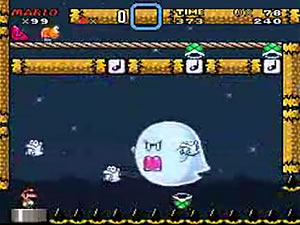 The sequel is where the real excitement is, though. The difficulty is ramped up immensely, but the inventiveness of the design is as well - the first level, in particular, is brilliant, though the opening sequence, which parodies that of the first game by allowing Mario to actually die, is a real highlight too. But the Big Boo fight at the end of stage 4 takes the cake. If the difficulty was toned down a touch, it could be something right out of Yoshi’s Island (which, personally, I’ve always felt is the most creative 2D Mario game by far). I’d love to see Kiba attempt to design a hack that’s a little more friendly, because he has a real flair for creative, inventive level design. His grasp of how the game works is exceptional, as well. The timing required in some sections, and the angles at which some jumps have to be made shows that.
The first part of the last level of Kaizo Mario 2 - or Asshole Mario 2, if you prefer - has only just been put up yesterday. Man was that worth the wait though. The moment just before the half-way mark is incredible, and I can only imagine how it must have felt to finally reach that half-way tape. I’m really looking forward to seeing what the rest of the level is like - I believe the original file is about 23 minutes long, though I’ll be damned if I can figure out how to download it from the Japanese site it’s on. Nevermind. I’ll probably say a few words about it next week, anyway, assuming it’s up by then.
———————
I’ve been reviewing a few games this week. The first was Surf’s Up for PS2, based on the movie which is out or is coming out or something. It looks so bland that I honestly feel like it’s already come and gone, though I might be getting it confused with Happy Feet. Meh. Anyway, it’s been a while since I’ve played a surfing game - probably since California Games in the late ’80s, to be honest. Surf’s Up, as it turns out, is surprisingly competent, for what it is: a kid’s game. I finished it in less than two hours. Still, it’s not without some merit, and I can imagine kids having a ball with it. The play mechanics are more or less based on that Tony Hawk type design: complete level goals, score points by completing tricks, etc. There’s an SSX style power-up bar to go along with it too, which can allow you to score eight times the amount of points in one special trick, but this is kind of what lets the game down. Essentially, it all boils down to repeating the same trick over and over again, since there’s no score-based punishment for doing so, until you fill the meter. Then throw out a few of the super tricks, then build up the meter again…you get the idea.
It often takes a little while to get my head around kid’s games. I can’t quite imagine what I would have thought of this game when I was younger; I grew up playing Thexder and Baal and games like that. They sure as hell weren’t easy enough to complete in two hours. In fact, I’ve never even come close to finishing them. It’s simple enough to say, ‘Well, this game is clearly aged at kids under 10′, or something like that, but I was playing those games - and having a blast - when I was eight. I mean, if I was starting off playing games nowadays, what’s to say I would actually want to play something like Surf’s Up? Maybe I’d rather play Gradius V. I’d probably be pretty crappy at it (actually, I am pretty crappy at it, but that’s not the point) but I’m sure I’d enjoy trying to do it. That’s why I kept playing Xenon 2 and Carrier Command.
I find kid’s games absolutely fascinating, though. I really like reviewing them, because it is really interesting to have to put myself in a different mindset. In this case, because it was for dB Magazine, I think it’s important to write towards parents - dB’s not really the kind of thing that would be read by the target audience for this game. And there’s no point writing towards a typical gamer audience, because they’re not the people who would even think about picking this game up. So it’s parents then, and, to be honest, I couldn’t see any reason not to say that I consider this a pretty competent children’s title. It’s certainly not the worst kid’s game I’ve ever played, and it’s fairly cheap. So, parents could do worse, I guess.
So I got that review written up pretty quickly, which allowed me to move onto the second game I’m reviewing: Atelier Iris 3: Grand Phantasm. I reviewed the second game last year, and wrote a relatively glowing piece about it. It was flawed - the story was pretty crappy, and the graphics are Dreamcast quality for the most part. But it was a lot of fun. I kinda felt a bit weird about that review afterwards though, and I wondered whether I’d actually been too glowing. Having played through the third one for about 10 hours now, I’m less worried. I know a lot of people consider the series the very image of the average and predictable JRPG, but I think that’s giving the game a lot less credit than it deserves. There’s a lot of really interesting things about it.
As with the second game, Grand Phantasm’s battle system is really engaging. It’s maybe not quite as exciting as its predecessor, but it’s still an interesting take on the genre, especially once you’re able to push enemy attacks back with regular weapons. Of course, as with the rest of the series, weapons are upgraded using alchemy. Again, the way it’s used in this game isn’t quite as interesting as the alchemy system in Azoth of Destiny, but it’s not too bad, and is infinitely more interesting than simply buying objects.
The story progression is well done this time around, too. The main characters are Raiders working for the local guild, which basically means that they’re just odd-job people, it seems. So, like the hunting system in Final Fantasy XII, you’re able to select quests for money and reputation points. Once you’ve built up enough, you move onto the next Raider level, and the story progresses. It feels a lot more freeform than the other Atelier Iris games - even if it’s really not.
The quests and missions take place around the town, or in areas accessed through gateways around the town. There’s five of these areas, called Alterworlds, and they’re all actually of a pretty reasonable size. The most interesting aspect of them is the fact that there’s a time limit within them, meaning there’s a kind of urgency to your exploration through those worlds.
The storyline is pretty bland, despite the good progression, and the character designs are…a little on the fan service-y side. Check out the differences between Viese from the second game and Iris from this one (image composition by of Durante on GAF). They’re both main female leads, but, wow. Pretty blatantly sexed up. Wait until you see Nell the bunny-girl, one of the supporting cast, or Eva who owns the town bar. I don’t even want to put pictures up here. It’s forgiveable, though, because the pacing of the game is really spot on - things move fast enough to keep your attention, and the quest system provides plenty of little tasks.
So, I don’t know; I haven’t finished it yet, so it might get a little old by the time I do, but I’m digging it so far, and I’m liking the fact that it’s pretty easy to just get 20 minutes of play out of it. The review is due in about a week and a half, so we’ll see how I’m feeling then, and I’ll throw in a quick update.
So, is that all I’ve been playing? Yep, it is. No Halo 3 here. I’m not much of a Halo fan, to be brutally honest. It’s a fun series, and is an absolute blast in co-op, but I really don’t dig the competitive multiplayer. And yes, before you ask, it is because I suck at it. I didn’t even play the beta, for that reason. So, I’ll buy it eventually, but it’s really not a priority. I’ll probably use the money I would have spent on Halo 3 on the Orange Box, because that’s got me excited as all hell. I’ve never played Half-Life 2 - I know, I know - but I can’t imagine getting a better chance than this. Plus I get Episode 1 and 2, Portal and Team Fortress 2? How could anyone resist? Roll on October 18!
Also, my HDTV is gone for repairs at the moment, so I don’t even have the 360 plugged in. Some problem with a processor or something, which meant that I couldn’t watch TV channels unless I was using the DVD recorder to view them. It just forgot how to hold a signal. A little annoying, but nothing that really worried me too much, cause I don’t watch much TV. When it decided to stop allowing me to use one of the AV inputs - the one the PS2 was plugged into - that’s when I gave up and just decided to get it fixed. Didn’t expect the guy who picked it up to tell me that it would take a week, but there you go. Fortunately, I had a spare TV…uh, out in the back yard. An old housemate left it here - along with a couch and multiple boxes of crap in the shed - so it’s been sitting on the back porch for months now, just in case he wants it back one day. It had a few leaves and some bird shit on it, but it seems okay. Watching TV and playing games on something literally half the size of my HD screen is a little odd, but given that I used a 34cm TV for six years, I can’t really complain.
———————
A few good comics out this week: my pick-up list is pretty strange, I guess, because I have a reluctance to jump on titles in the middle of runs, and I find the DC universe too confusing to even attempt buying anything. Yes, that’s stupid and stubborn, and means I miss out on a lot of interesting stuff, I’m sure, but that’s how it is.
That said, I did jump on Cable & Deadpool pretty recently mid-run. I’ve always liked what I’ve read of Deadpool, but Cable just doesn’t do it for me - reminds me too much of the excesses of the ’90s, though I say that without having actually read any Cable stuff since about 1995. In the end, it was the aforementioned GLI/Deadpool Summer Fun book that convinced me to give it a shot. And, hey, Cable’s dead now anyway. Timing, eh?
It’s a great series, though. Fabian Nicieza is a brilliant humourist, and penciller Reilly Brown compliments that perfectly, with a style that conveys movement incredibly well, but deals with emotive comic timing even better. Issue 45 isn’t as funny as its predecessor, but it’s still a damned good read. Deadpool and Hydra agent Bob are sent back in time to WWII thanks to a temporal hiccup at the end of the last issue, and while it could have easily denigrated into something either stupidly nostalgic or annoying condescending, Nicieza’s characterisation of the golden age Bucky and Captain America was terrific.
Bucky especially, since Nicieza is putting it through the filter of his recent revival as the Winter Soldier, and the revelation that went along with it regarding Bucky’s work as a covert government mercenary during WWII - behind Cap’s back, Bucky is needlessly aggressive and violent, and swears constantly. There’s one panel where Bucky moves suddenly towards Bob with a knife, which is just fantastic: it’s a close-up of his face, but the sheer feeling of movement is so well done and the aggression in that move is really well done. Of course, once again, it’s Bob who steals the limelight - the idea of a nervous enemy agent with a rambling inner monologue tailing along with Deadpool is still endlessly amusing. With Dan Slott moving away from She-Hulk to write Spider-Man, this pretty easily takes the title as the funniest book coming out of Marvel right now. This issue’s a good example of Nicieza’s ability to tone that down, though, and there’s a good connection between Cap and Deadpool. In fact, it might have been nice to see this stretched out over two issues rather than just one, but the pacing of the series is hard to fault, really, and is a real part of why it’s such fun to read.
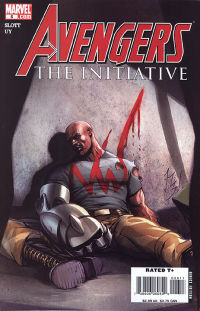 Speaking of Slott, he’s still sticking with Avengers: The Initiative, however. It’s been a great series so far, mostly because his characterization is so interesting, and the focus on different characters has worked well to expose different facets of the team. Issue 6 isn’t as strong as previous ones though, unfortunately.
Mostly, it’s just down to the fact that there’s a fill-in artist. Stefano Caselli’s art is such an integral part of the book - it’s balanced well between cartoony and realistic, and his action scenes are really punchy and impactful. It’s his facial expressions that are the real draw though. It adds a lot to the believability of the characters.
So, it’s pretty sorely missed, with Steve Uy stepping in for one issue - at least, I hope it’s only one issue. I’m pretty sure it is. Uy actually takes on all of the artistic duties for this issue, it seems. He’s not a bad artist, but his expressions lack subtlety, and he could do with having someone else ink his work, rather than doing it himself - it lacks a lot of definition, and often looks blurred. His colouring is pretty well suited though, with a flat pastel-dominated palette. His work would probably be overshadowed by anything stronger.
His layouts are the biggest problem, though. If it were more dynamic, his pedestrian art wouldn’t matter so much, but it’s just so flat, especially in comparison to Caselli’s layouts. It makes Slott’s scripting seem less interesting, as well, as it takes away a good deal of the impact that comes from Caselli’s expressive and dramatic work. Without spoiling it, this is a particular problem on the last page - it should have been more shocking and worrying than it is, but it’s just…plain. There’s nothing there that really has any feeling of weight.
And maybe it is just down to the art, but Slott’s story feels less focused than previous issues, and more meandering. It doesn’t feel like it’s furthering what’s been set-up previously, and it doesn’t feel like it delves particularly deeply into the personality of Gauntlet, the issue’s focal point. Hopefully the next issue will be back on track a little more, because it’s been a great book up until now.
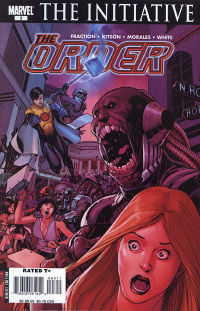 Matt Fraction’s The Order, on the other hand, remains as focused as ever. Marvel’s got some amazing writers working for them at the momen, and Fraction is right up there as one of the best. As with Slott and Nicieza’s work, it’s the grasp of character that Fraction clearly has that makes him such a pleasure to read, and there’s some brilliant characters in this book. In issue 3, the team face hordes of zombie hobos - or, zobos. It’s funny enough, but it’s not even really the focus; this is really based on character more than anything else, and the way each issue has zeroes in on a particular character while still being able to expand the roles and mannerisms of the supporting cast is masterful. Super hero comics don’t come much smarter than this.
It’s great seeing the team get more and more fleshed out as time goes on. James Wa, the feature of this issue, showed a little weakness last time around when he refused to kill cryogenically frozen Russian soldiers, but he’s built on marvellously in this issue, and shown to have some real hang-ups. Henry Hellrung, the team leader, is still probably the most interesting character, though - before receiving super powers from the government, he was an actor playing Iron Man on TV, and then a drunk, much like Iron Man himself. In fact, the first issue showed the two at AA meetings together in a flashback, which was a nice touch.
It’s Barry Kitson’s pencils that are the real key to the effective characters in the book, though. He’s got a knack of being able to draw slightly exaggerated figures that still look very much like real people, and the subtlety in his expression work is really top notch. So is his use of pauses in his layouts. Really great both dramatically and comically. It’s a really fascinating book, and it should be well worth sticking around to see where it goes in the future.
———————
I picked up a couple of CDs for review when I picked up the games from dB as well. Okay, maybe a couple is a little bit of an understatement - because I was sick last week, and was still trying to finish up a big pile from last time the week before I haven’t been in for about a month. Which meant that there were another 10 CDs sitting in my pigeon hole. That is, of course, cool with me, since I love the fact that I’m able to experience new stuff through dB like that. Let’s move through them quickly, and I’ll hopefully be able to write a little more about them as I review them over the next couple of weeks. Or maybe not.
 This is How I Hear Your Voice is the début EP for local Adelaide artist Zeal, and it’s a great piece of work. He’s got a cool style: sort of indie rock with beats, and his voice is pretty good too. If anything, it suffers a bit from the fact that Zeal is trying to explore so many facets of his music in just five tracks - there’s also a guest appearance from local MC Subsketch - but it’s definitely a promising start. Should be great to see where he goes from here.
Similarly cool and local is the début from The Brels: Parasites, Poptarts. Unlike Zeal, though, the guys in the band have been around for a while in other guises, so there’s a real sense of experience there. The album is pretty pure indie pop, and they have a great complexity and texture to their music. There are a few songs that aren’t quite up to the standards of the really great tracks - that is, there’s a couple of duds - but it’s a solid album, ultimately. They’re launching the album at the Jade Monkey in Adelaide next Saturday - the 6th - so that should be a really interesting night. They sound like they’d be a good live band.
Keeping things reasonably local still, former New Zealanders and current Melbournians Batrider have released their first album in Australia. And…Tara is probably the Australian album of the year at this point, as far as I’m concerned. Kid Cornered’s self-titled effort is a close second, but, honestly, I can’t get enough of Sarah Chadwick’s vocals. She’s furious, fearlessly emotive and screams like…I don’t know. Like Courtney Love being eaten by Nick Cave, who then regurgitates her into Kathleen Hanna’s mouth. Or something. Either way, it’s revelatory, and so filled with brilliant melodies and absolute passion that it’s impossible to ignore.
Perth…uh, what are people from Perth referred to as? Perthians? Perthicans? Erhm, nevermind. Point is, Jeff Strong is from Perth and plays some really interesting folky country, with a wicked sense of humour behind it all. Australian country can bepretty touch and go - I mean, hell, we’re responsible for unleashing the horror of Keith Urban on the world - but Strong manages to make music that is really Australian feeling without being cringe-worthy. His voice is initially a little jarring, but it’s really quite charming once you get used to it, and I think I really like it now. Especially on tracks like Eternal Darkness and Railroad. It’s a good album, all up, but it probably won’t get a lot of attention. Strong doesn’t seem to make it out of Perth much either, which is a pity, cause I’d love to see him live.
Science Fiction Illustrated, the second album from Glaswegians Mother and the Addicts is surprisingly good, given their crappy band name. There’s elements of !!!, Blondie, Gang of Four, but with a really Scottish air to it all. It’s very cool, and has about ten times more personality than anything by Franz Ferdinand. The début for Bumblebeez, Prince Umberto and the Sister of Ill, is also very cool. I haven’t listened to it terribly thoroughly yet, but I like what I’ve heard - kitchen sink indie electro. Nice. And who knew people from Canberra made music like that? I’m also yet to really get my head around The Weakerthans‘ Reunion Tour, but, again, I’m liking what I’ve heard of it.
I received a promo copy of The Scare’s debut Chivalry in the mail for an interview I did with their bass player the other day. I’m not a big radio listener, but I gather they’re getting quite a bit of airplay, which isn’t even close to a surprise - it’s seriously catch, very arch post-punk. They kind of remind me of Rocket Science, but with more focus on guitars, and a bigger drum sound. It’s really catchy, and really energetic: Ghetto Psalms in particular is an immediate classic. I’m looking forward to seeing them when they hit town on the 3rd of November.
I’ve also been listening to a bootleg of Bruce Springsteen live in 1978 that I found on the very cool Captain’s Dead blog (part one, and part two). I’ve not really heard a great deal of Springsteen - one of many artists that I just haven’t had a chance to get into - but this is a great gig, and well worth a listen. Pity the track listing is messed up, but maybe it’s fixed by now. Either way, it’s a real good show of why Springsteen has the reputation for great live shows that he does.
———————
Phew, well, that was a lot of writing. Hopefully next week won’t involve quite so much chatter from me - I’m probably going to be playing the same thing(s) and listening to the same albums, I’d wager. Nonetheless, be back here in a week for more of the Little Mathletics Shipping Report. I’m-a try my best to get this out every weekend. Let me know what you think.
Oh, and finally - go Cats! Geelong won an AFL premiership for the first time in 44 years, which is pretty amazing. As someone named after a former Cats champion, naturally this is a little bit exciting for me. I’m no football nut, but it’s hard not to be proud.
No Comments to “The Little Mathletics Shipping Report (23-29 September)”
Please Wait
Leave a Reply