The Little Mathletics Shipping Report (21-28 October)
0 Comments Published by alistairw October 30th, 2007 in Shipping ReportAnother week, another column! Why so late this time? Errr…funny story. I’ll get to that later. Let me begin here by saying that we’ve had absolutely no interest in the competition. Admittedly, it’s a bit restrictive saying, ‘Oh, here’s some stuff but you can’t enter if you’re not Australian’, but whatever. I guess the fact that pretty much all 360 faceplates other than the default are ugly anyway doesn’t help. Anyway, if no one wants it, then, well, I’m not sure what I’ll do. Don’t people want free stuff these days? Crazy.
Bit of stuff to get through this week - couple of games, few CDs. Haven’t been into town for a few days so there’s not actually any comics to talk about. Maybe I’ll edit that part in after I duck into town tomorrow.
———————
Let’s talk music first. This (last) week, I had the pleasure of doing two interviews for dB Magazine. One was a face to face, the other over the phone. One was exciting, one not so much.
The face to face - the less exciting one - was a really last minute thing with (pretty average) Australian pop group Rogue Traders, featuring another former Neighbours star, Nathalie Bathingthwaite. That’s two down, then; 200 or so to go. They were nice enough, but the 20 minutes we had dragged out really badly for the last five - I would have happily left after 15 and could have made my article word limit just as easily.
The phone interview was much more exciting; kind of nerve wracking even, for the first minute or so at least. It was with Ed Kuepper, founding member of pioneering Aussie punk band The Saints, and formidable solo artist in his own right. And prolific too: he released 18 albums in the 1990s alone, and that’s not even counting compilations. That’s incredible. I pretty much grew up listening to him thanks to my dad, but it took me a while to realise Kuepper really is a great artist - it’s not the same as, say, appreciating ELO because you grew up with them or something. His 1991 album Honey Steel’s Gold, if you haven’t heard it, is a good starting place - for an album that’s over 15 years old, it stands up spectacularly well.
I spoke to Kuepper about his new album with his band The Kowalski Collective, Jean Lee and the Yellow Dog. It’s essentially a kind of loose concept album about the last woman to be hanged in Australia - and the only one to be hanged in the 20th century. The story itself is pretty interesting, but the really interesting facts are in the little details, which are a little more complex than I have the time to explain here, so you could check this entry in the Australian Dictionary of Biography if you’re curious.
The basic gist is that Lee was a single mother in Sydney in the ’40s, who in order to survive became a prostitute. After a while, she formed a relationship with conman Robert Clayton, and the two would, apparently, blackmail married clients. Between May 1945 and July 1948 she appeared in court 23 times, on mostly minor offences. In October 1949, she travelled to Melbourne with Clayton, and met up Norman Andrews. Then, in November of that year, the three were involved in the murder of 73 year old bookmaker William “Pop” Kent.
The details are pretty cloudy on that event, but Lee confessed, and all three were sentenced to death. There are questions about whether or not she was actually guilty, or whether she just confessed to try and save Clayton, figuring that a woman would not be sentenced to death, and that she would receive the brunt of the law - assumedly life in prison. Kuepper’s album, which features lyrics co-written with his wife Judi doesn’t really make suppositions, but leave it up to listeners, which seems like a good move to me.
Not that it really tells the story in a coherent narrative either, though there are plans for a stage adaptation. It’s more an investigation of the people involved than anything else.
It’s a dense album, and that’s almost surprising in a way - it’s a really claustrophobic in parts, and quite abrasive at times too. Even the quieter moments have a reasonably intimidating atmosphere to them. I like it a lot, basically.
Kuepper was really great to talk to, incidentally. He was happy to talk at length about the album and was really open about his thoughts on what it represented in his career and so on. Should be great once I write it up. And unlike the Rogue Traders interview, I could have easily talked with him for another 20 minutes. Hell, another hour. Really truly fascinating stuff.
I’m slowly making my way through that pile of CDs on my desk now. There are a couple of disappointments, mostly in the form of Hawnay Troof’s Dollar and Deed, a double album that sounds like a lost solo album recorded by Adrock in 1992. It’s really pedestrian in terms of its music, and the rapping is just irritating - there’s no subtlety, it’s all just in your face all the time. Which would be fine for an EP, maybe, but not for a double album. That’s just self-indulgent.
I’ve been enjoying the new Mendoza Line album, 30 Year Low. It’s only eight tracks, but there’s a second disc of live and rare stuff, because this is the last album Timothy Bracy and Shannon McArdle are doing together. They’re now divorced, which is sad. So, there’s a little bit of bitterness in the new music, and a lot of sadness. I’m going to have to listen to it a bit more before I can really get a handle on the mood, but the songs are great, especially the duet between McArdle and Okkervil River’s Will Sheff. I love a good duet, and I love Okkervil River, so it’s like they put that one on just for me. I’m touched.
Nervous Jerk’s ESP compilation is predictably great. The label has been a visible force in promotion and recordings in Melbourne for a while now, and over 23 tracks they’ve put together something really special. It’s got Crayon Fields, who I adore, and the side project Sly Hats, as well as Eddy Current Suppression Ring, The Stabs, My Disco, Calvin Johnson, Michael Yonkers and more. A couple of tracks are a little on the disposable side, and there are one or two that I could have done without, but for the most part, I can’t fault it.
I’ve only listened to the solo album for Gomez vocalist Ian Ball once or twice, but I like what I’m hearing. Who Goes There is a lot smoother and simpler than Gomez. It’s just well put together indie pop with a lot of heart. And you can’t ask for more than that. The second album for Celebration, The Modern Tribe, is another one I need to put a bit more time into. I’ve run it through a few times, but I’m still getting a grip on it. It’s psychedelia with a dash of beats and a great female vocalist in Katrina Ford, but it hasn’t quite clicked yet. That’s not to say I don’t like it - I do - I’m just not at the point where I can say exactly what I like about it yet.
Finally, I received the new Jeffrey Lewis album in the mail. 12 Crass Songs is, as the title suggests, 12 covers of songs by the punk band Crass, redone by Lewis: he changes the music, and updates the lyrics in a few place. It cost me a little over $30, but he’s also donating half the profits to charities that the band would approve of, so that’s great.
He says in the liner notes that when he first heard them he was struck by the fact that their music is so aggressive, yet the lyrics are reminiscent of ’60s counter-culture. They’re remarkably literate, and are worryingly relevant even now.
Lewis’ music took a step up in complexity with his last album, City and Eastern Songs. His first was mostly 4 track recordings, and occasionally just tape deck recordings, so it’s not as if he didn’t have a lot of space to move, but he’s doing some interesting work with layers and percussion these days, and it’s really quite lush in some places. 12 Crass Songs is maybe even more melodically focused than City and Eastern Songs. It only arrived yesterday, but I must have listened to it 10 or more times by now - it’s really that good.
———————
So, why is this late? It’s pretty simple: The Orange Box ate my weekend. It got pushed back to the 25th - though I found a copy on the 24th and finished Portal that night. Then I spent the whole weekend playing through Half-Life 2 and Episode 1, with big patches of Team Fortress 2 as well.
Let me put this bluntly: if you own a 360, and you don’t own this game, you should feel bad about yourself.
I’m ashamed to admit that I’ve never played Half-Life 2 before, having never had a PC up to the task, but I can see what the fuss was about. It’s incredible. The updated graphics in the Orange Box version, which use Valve’s HDR lighting techniques as seen in Episode 1 and 2, are great. There’s a really dense atmosphere about everything. I thought the notorious linearity might be a little off-putting for me, but it hasn’t bothered me one bit. I finished up Episode 1 last night, and I’m about midway through Episode 2. It’s all just stunning stuff - the locales and characters are so full of life. Why didn’t anyone tell me? Jeez.
Portal, however, is the real highlight, and is deserving of all the praise you’ve probably heard about it. Aside from being one of the most inventive games of recent years in terms of its mechanics, it’s also hilariously funny. I don’t want to spoil it for anyone, but the character of GLaDOS, the computer who guides you throughout the game, is terrific, both in terms of the voice acting, and in terms of actually complexity. And as for the ending? Wow. Mind blown.
Team Fortress 2 is actually a little hit and miss at times. If you’re on a team and everyone is in voice talking it all through, it’s more fun than any other multiplayer game I can think of. But if you’ve got a team of people who won’t talk, and who attempt to win the match themselves, then it just falls to pieces, and can be really irritating.
I’m often reluctant to use my mic, because there’s not a lot of point in, say, FlatOut or Blazing Angels 2. But I can’t think of any game that it’s more necessary in than this one. I played with a bunch of other Australians the other day, and that was a blast. I’ve got a few of them on my friends list now, so hopefully we’ll be able to do it again sometime. I just wish I knew more people playing it, because it’s a game that really thrives on communication and being able to have a laugh with the others on your team.
Minor quibbles about team mates aside, and now that the lag issues are mostly fixed, I’m loving it, and can see myself playing this for a long, long time. It’s cool to have finally found a multiplayer game that really clicks with me. Here’s a gif of me playing, just for a bit of fun. That’s over around 45 minutes, which is a bit worrying. I seem to stand a lot while I’m playing, it seems.
I found a little time to touch on Clive Barker’s Jericho on Saturday. I’d had it for two days at that point, but it got caught up due to an issue with not being able to take the Orange Box disc out of the drive, if you know what I mean. In short, it’s a shooter, and you shoot zombie demon things. Oh, and you’re on a special ops team…of witches! The end.
Ehh, I’m being harsh, but it’s really nothing special. You can switch between players on your squad after an event in the first level, but it doesn’t quite work. They all have different powers, but switching is too fiddly to do in the middle of a battle, which takes away some of the use of it. In addition, when you’re not controlling them, your team mates are so blindingly stupid that it takes all the fun out of the game - I feel like I spent more time healing them than fighting.
And what do they do after you revive them? Do they go and heal the other hurt squad members? No, they go and stand in the open and fire at the enemy. And then die. Repeat ad nauseum. For a special ops team, they don’t seem to have a very good understanding of cover.
It’s just bland, really. The only game breaking flaw is the AI, but the rest of the game, which could have made up for it, is nothing short of boring. Barker’s designs may have been pioneering at one point, but they’re generic these days. Oh, slimy things? Didn’t I fight them in Gears of War? Or maybe it was one of the other hundred shooters on the 360. Bleh.
Oh - I’m back with the guys at Strategy Informer, the UK gaming site, so I’ll be doing a few reviews for them soon. Coming my way: Crash of the Titans, the new Crash Bandicoot game, and, erhm, Horse Life for DS. I don’t know a whole lot about the game, but apparently I can “purchase over 80 different items such as clothing, saddles or food and treats” for my horse, as well as entering it in horsey competitions. Rad.
———————
More next week. I’m going to see The Scare on Friday night, so that should be cool. I’m post a few impressions here. There should also be a few more CDs to talk about as I continue to make my way down the pile. And I’m interviewing Faker this week too, which is…eh. Not terribly exciting.
But oh well. I’m off to save the world from the Combine now.
Little Mathletics Official Game Crap That I Don’t Want Giveaway
0 Comments Published by alistairw October 22nd, 2007 in CompetitionsYes, it’s time to win some crap that I don’t want. For this, the first and quite possible last Little Mathletics giveaway, we’re proud to offer you the chance to win some fine Juiced 2: Hot Import Nights gear, sort of courtesy of the nice folks at THQ. I say “sort of” because they didn’t actually specifically say I should give it away - I’ve just got no use for it and thought someone out there might like it more. Is that person you? Would like a fabulous Juiced 2 promo CD and an Xbox 360 faceplate, as shown here with our lovely model, Nobby the Cat?
Well then, simply answer this question!
What is the subtitle of Juiced 2 not a reference to, much to my chagrin?
I mentioned it somewhere in one of my posts, so get reading! Then, once you’ve got the answer, send an email to [email protected] with the subject “Juiced 2 Competition”. Then I’ll use some kind of random function to pick a winner. Possibly it will be something to do with printing out the emails and seeing which one the cat eats first.
Unfortunately, due to the fact that I’m kind of poor and the postage is coming out of my pocket, the contest is only open to residents of Australia. If you live somewhere near me so I don’t have to post it at all, that would be even better, but I won’t restrict things that much.
Anyway, get reading, get emailing, and get winning. Competition closes on the 4th of November, and all decisions made by the cat are final.
The Little Mathletics Shipping Report (14-20 October)
0 Comments Published by alistairw October 21st, 2007 in Shipping ReportWeek four of the Shipping Report, and we’re actually on time for once. Well, more or less: it’s the same weekend as the date indicated up to, and that’s good enough for me. With the short time in between the last post and this one, there’s not a whole lot to talk about this week, which should keep it a lot shorter, but we’ll still be covering the usual bases: music, games and this weeks comics haul. I haven’t really noticed anything around the web to point out either, to be honest, so it really will be a short week.
———————
So I went into dB and picked up the games in my pigeon hole. Juiced 2 was indeed there, along with some other Juiced related stuff that I’ll get to in a sec, as was Buzz: The Big Hollywood Quiz. Unfortunately, despite packing the game in a gold coloured film canister and including some kind of bonus disc along with it, there weren’t actually any controllers, and the game requires them. That seems like the kind of thing that I’d check before sending it out if I were a Sony Computer Entertainment rep - especially if the game was in aforementioned gold film canister - but nevermind. Maybe someone will join the review team at some point who actually does own the controllers, and we’ll get the review out in six months time. Or maybe Sony will send through some of the controllers. Either way.
Instead of taking that, then, I found that our lovely Activision rep had been kind enough to send through a copy of Tony Hawk’s Proving Ground, which I’ve spend a good half of the weekend playing. I didn’t play Project 8, but I did play most of them up to that point, and this is still pretty much the same game that I remember playing on the Nintendo 64. I mean, sure, they introduced a coherent world in the fourth game, along with crappy platforming segments, and this one has new career based goals that allow you to choose your path to some degree, but it’s still frustrating and imprecise as all hell. I’ve just turned it off in the lounge room, actually, and haven’t felt this outrageously frustrated over a game since…Spider-Man 3, I think. Hey, another Activision game! I’ll try not to draw conclusions from that.
Seriously though, I can’t understand how there are still the problems that there are. Certain goals at hard to achieve just because the game doesn’t explain how to do them properly, or because the controls are just too touch and go, and you have to rely on sheer luck to ever do them. Why is it still so hard to string combos together? SSX showed a great way of setting up chains using the right analogue stick almost six years ago. It’s not impossible, of course, but it’s just so dead boring these days.
I haven’t played skate., it’s worth noting. EA’s skateboarding game has been getting some pretty good reviews for its innovatio, and seems to have pretty much cornered the skate sim market right from the outset. Tony Hawk, on the other hand, seems to be taking baby steps in this direction with each passing title, though not really in a way that makes any kind of sense. That is to say, they’re including moves like reverts and so forth, but other than that, they’re just content with making the game harder, with more ridiculous scores needed to progress. It sucks the fun out of the game.
I mean, I was pretty reasonable at the second game. I didn’t quite finish it, but I got up to the last level, and I probably wasn’t far off getting the required score. Now I need to score 250,000 points in 1:30 and I’m only getting 2,000 per trick? That’s frustrating, not challenging. Especially when the damned controls haven’t even really changed since the second game and the moves are still done by entering one of about a million different combinations.
Yeah, there’s the Nail a Trick mode, which allows you to spin and flip the board in slow motion using the analogue sticks when you’re in the air. But it just makes it even harder to try and flip the left stick up and down to enter a manual after that to try and score a combo.
And the skate checking? Whose stupid idea was that? Seriously. I’m playing this game to skate, not to try and chase some guy through a skate park while periodically checking up on my buddy and trying to defend him. Escort missions are bad enough in action games, let alone games where people have been complaining about the non-skating sections for four years now. It boggles the mind. I try not to get too hyperbolic, but it really is one of the stupidest design choices I’ve seen in a game of this standard for some time. Tragic, annoying and enough to make me want to stop playing completely in some kind of protest, although I did manage to get through it eventually.
It’s a pity that the game just hasn’t moved on enough, or in the right ways, anyway, because the way it’s all set out and the progression of the story is pretty fulfilling, and it were actually a little easier to progress it would probably be a great deal of fun. Though, still kinda stale. I really am still trying to figure out exactly what I think of the game - these are more just impressions from a few hours play. I gather that there are certainly things that will make doing manuals easier later on, though chances are the game is going to have ramped up in difficulty significantly by then.
Juiced 2 is another game that’s been frustrating me over the time I’ve been playing it. It’s fun, and as you can see from the picture I took (with a camera - thank god for LCDs) I really like the character creation part. It’s an odd habit of mine to create the ugliest character I can, and probably best not to ask any more about that really. The race tracks are well designed, and for the most part the difficulty is set pretty right. It looks great too.
I have no idea why, but I’ve always really enjoyed arcade racing games like this. I liked Need For Speed Underground, and while Carbon was a little less enjoyable, I still put a fair bit of time into playing it. I have absolutely no interest in the scene in real life, but I really like placing decals on cars in games. I can’t explain it. But, oh god, the drifting. I understand that it’s part of the scene, and should be included, but challenges like scoring 500,000 points in a single drift just give me a headache. Especially, as in Juiced 2, when you need to complete those challenges to upgrade your car properly.
Basically, you’re given new upgrades whenever you unlock a new league, but there are three different levels of upgrades for each league. In order to unlock the second and third tiers, you need to complete challenges. Most of the aren’t too bad - general fastest lap, or beat the overpowered car with a headstart kinds of deals. But there are two that just make me want to pitch the controller out the loungeroom window: the speed check, and the drift endurance. The speed check challenge is much like the fastest lap challenge, but with the added difficulty of having to keep yor car above, say, 88kph at all times.
But the drift challenge is a killer. Obviously, there’s some kind of art to it - I’m not suggesting it’s inherently broken or anything. But it’s ridiculously hard for what it is, and causes unnecessary spikes in an otherwise level difficultly curve. And it’s unsatisfying when you can’t even get close to completing a goal like that early on in the game. It makes me feel like I shouldn’t be playing the game, to some degree, and that’s not a good thing for a struggling franchise like Juiced.
After all, the first game had issues with even making it to market. It was caught up in the collapse of Acclaim, and made it to review for a few magazines, ending up with some very average scores. When THQ picked up the property, they allowed it another six months development, but it didn’t seem to help all that much, and the game has been viewed a lot more harshly than it probably would have been without the release problems. So the second one really needed to be something special in order to make people realise that the series is capable - especially with the release of Need For Speed Pro Street right around the corner. It’s just not, though. Not at this point of my playthrough. It’s fun, but it’s not special, which is a pity, because I actually really wanted to like it a lot.
Oh, and as I said, I scored a few bonuses from THQ with the game, namely a 360 faceplate, a promo CD for the soundtrack, and a windscreen cover, which is really awful and which I didn’t even take home. And, even though I did take the CD and faceplate home, I don’t actually want them either. So, keep your eyes open for the very first Little Mathletics Official Game Crap That I Don’t Want Giveaway in a few days. It’ll be fantastic. Or, more likely, totally underwhelming in terms of response and I’ll end up having to keep the “prizes” because no one will email me. C’est la vie.
———————
Actually, there hasn’t been a whole lot happening on the music front this week. I’m still trying to get through the other albums before I start listening to the new ones, so there should be more to say on that next week. I’ve done five over this weekend, with another four to go, so I should be listening to them as of Tuesday at this rate.
One thing I have done is buy even more vinyl. I’m really bad when I get like this - I get ideas for songs I want to play to people and try and hunt them down on vinyl. I did that with Pump Up The Volume by MARRS, and then got dragged into buying more from the same guy to save on postage. So now I have a copy of The Model by Kraftwerk and…er, a copy of Sucker DJ by Dimples D. Yeah, I know, I know. Impulse buying, eh?
I received the two Santana albums, and can’t wait to play Oye Como Va for people. Then while I was in town the other day, I stopped into one of my favourite record stores to check their second hand vinyl. They’ve got very little, but their CD stash is so good I thought it would be worth a shot.
And I was totally vindicated too - I found an almost mint copy of Birds of Fire by Mahavishnu Orchestra, which is one of my all time favourite prog albums. The band’s first release is slightly better, in my opinion, but Birds is still a great find for $10. Here’s a link to One Word from the album. It’s a little long to be throwing into a set, I’m thinking, but it’s stunning, isn’t it? Billy Cobham is simply one of the finest drummers I’ve ever heard, and that clear bass is to die for. Very awesome. Oh, except for that shot of the uninterested audience in the middle of the drum solo. Heh.
I think I’ll go with Open Country Joy, if anyone is interested. I can’t find any trace of it online, but believe me when I say it’s some seriously funky jazz fusion, with a guitar solo that will blow minds, with a little bit of luck.
———————
That brings us very swiftly to this week’s comics, of which there are only two, and of those, there’s only one I’d even recommend. Let’s start with the less impressive one, though - issue #2 of Marvel Comics Presents. It’s by no means a bad comic, but it’s just not really worth buying. I’ve given it two issues, and while I might stick around for a couple more, just to see one of the stories through, it’s not something I could buy every month.
Being that it’s made up of four stories each month, at up to eight pages each, you’d expect that they would be designed to hold interest a little better than they do. As it is, there’s only two stories in the latest issue that I found particularly compelling. Stuart and Kathryn Immonen’s Hellcat story is good fun, even if the pacing in the most recent one felt a little off. This is the one I’m going to see through to the end, mostly because Stuart’s art is just brilliant. I love his movement and posing, especially in this part where characters are yelling at each other, and the facial expressions have a great sense of comic timing to them.
Wade von Grawbadger’s inks are great too. I haven’t actually seen any Immonen art without it, to be honest, but that’s probably a good thing - they’re just so well suited to each other that I can’t even imagine Immonen working with anyone else. Dave McCraig’s colours are worth a mention too, as they’ve got a really nice sense of shape to them, which is particularly important with Hellcat’s plain yellow costume, and the fact that Immonen’s figures are mostly just heavily outlined, with a few strokes to give a basic shape.
The art in the Vanguard story is wonderful too. I’m assuming, judging by the credits, that it’s pencilled by Dave Wilkins and then painted by colourist Tony Washington. Whatever the case, the light and shade is beautiful. The main character, a policewoman dealing with a murder that appears to be superhero related, is maybe a little too “attractive”, but that’s to expected, I suppose. The rendition of Reed Richards, on the other hand, is just vaguely grotesque, and works nicely, especially given the shadows of his workshop/laboratory.
The story is well paced, as you expect from a serial of this nature, but at twelve parts it’s a little daunting. I’m curious about what’s going to happen, but I can’t help wondering if the comic is even going to be around that long. It’s US$3.99, which is quickly becoming a second standard level for comics, but for something that is really just a showcase book, it’s a little too much. I haven’t seen sales figures (because, honestly, I don’t care about comics sales figures) but I can’t imagine it’s doing particularly well. If it sees issue #6, I’ll be a little shocked.
Because really, who’s going to buy a book for that price when only half of it is even interesting? The Taskmaster story has some nice art, but it’s nothing to write home about. It’s a bit rushed at times, even if the action sequences work well with that kind of roughness. The Weapon Omega story is just dead boring, though. The art is average, and the story ties in with Omega Flight, the Canadian superhero team, and some kind of mass consciousness that has come from the pages of X-Men, I believe. Or something. I don’t know, and I don’t really care. The characterisation of U.S. Agent was the only thing that made it worth reading last time - the main character, who I guess is the titular weapon, and holds that consciousness, is just flat. And it’s another 12 parter. Count me out.
Marvel could be doing some interesting things with this book, but what’s been shown so far just isn’t living up to its promise for the most part. It’s a wasted opportunity.
Contrast that, then, with the best book coming out of the publisher right now: Captain America. Sure, the title character died six issues ago, but those six issues have been nothing short of stunning on every single level. Steve Epting’s art is just incredible: his faces are expressive and full of life, and his movement is full of impact. There’s excellent lighting, and great use of heavy inks to create some really dense feeling shadows. The covers have been wonderful too, with a real “movie poster” quality to them.
And it all gels perfectly with the scope of Ed Brubaker’s writing, which has been full of action and plot twists, while still retaining a level of believability to the characters. Things haven’t exactly been moving fast, but there’s been enough happening to keep the pace rolling at a really nice level. And obviously, it takes a fair bit of talent to not only be able to write a book where the title character is dead and have it be interested, but also write it well enough that I honestly don’t feel any desire to see Steve Rogers back any time soon.
Most impressive is the lack of angst. So many writers, when writing something that’s “dark” will just go with an immature anger. A lot of the X-Men books of the ’90s did this. In fact, a lot of the books of the ’90s in general did this. The fact that Brubaker can write a book that is genuinely dark in tone without resorting to clichés in that way is impressive.
Honestly, if you’re going to pick up anything in trade paperback form this year, Brubaker’s run on Captain America really should be on that list. It’s a great example of just how good mainstream comics can be.
———————
Well, that really was (relatively) short. More next week, and keep an eye out for the competition in the next day or so. I don’t want any of that stuff, so you may as well try and win it, or something.
The Little Mathletics Shipping Report (7-13 October)
0 Comments Published by alistairw October 17th, 2007 in Shipping ReportBack again! And a day or so late, once again, but hopefully this will all be worth the wait, especially considering my promises of special updates and so forth. It’s been a reasonably busy week in some (life related) regards, but I’m still going to try and get through all this as speedily as I can.
Website-wise, I’m a little concerned that the images are making it hard for some people to view the site. It takes a few seconds to load at my house, and my Year 12 Information Processing and Management teacher told me that the page should load as quickly as possible so as not to annoy people and drive away prospective traffic. Of course, most people I knew back then had 56K modems still, so maybe that’s all changed and maybe most people have faster internet connections than my fairly sluggish 512K one. Probably. Ain’t Australian broadband grand? Vote Labour, kids.
Actually, speaking of the upcoming election, I am glad to hear that we finally have a date: 24th of November. That’s just before my birthday, so if anyone’s stuck for what to get me, maybe just vote for Labour instead of actually buying anything, eh? That would make me super happy. I’m not ashamed to admit that I bawled like a little girl after the last election, and I’m not afraid to do the same thing this time around. That said, despite the strong showing in the polls, I’m trying not to get my hopes up about a Rudd government getting into power. It’s better if I don’t.
Still, the facts are hard to ignore - there are polls showing swings of up to 16% in some divisions, and that’s pretty heartening. The seat I’m living in, Hindmarsh, is one of the most marginal seats in the whole country, though. Steve Georganas, our sitting Labour member, only got in with 50.06% of the vote last time after preferences. This time he’s up against Liberal member Rita Bouras who appears to be attempting to play off the high aged population of the seat by promising improvements to aged care - not exactly something the Howard government has excelled at.
I may or may not be about to cut down the propaganda she’s tied to the light pole in front of my house.
———————
 I know little about classical music, on the whole, but I do, as they say, know what I like. I developed something of a fascination with Jascha Heifetz a few years ago, mostly due to the fact that his grandson, Danny, played in Mr Bungle (and is currently living in Sydney, I believe). I haven’t exactly built up a collection or anything, but I’m always amazed at any footage of him I see, because it’s obvious even to me that he really was one of the greatest violinists of all time.
This video on YouTube is probably the best introduction I can find. It’s a little hammy at the start, but it does reference his legendary perfectionism, at least. I understand that he received some criticism for this search for perfection - apparently it did, to a degree, make his work a little soulless at times. As someone who appreciates lo-fi passion far more than shiny perfection, I can see where those critics would be coming from, but I don’t really feel that way myself. I’ve always felt that being able to play to this degree of virtuosity is sign enough of extraordinary passion for the music you play.
Plus, there’s also the fact that - according to legend - Heifetz requested that microphones be close enough to his violin that people would be able to hear the scratching of the bow across the strings, and the movement of his fingers. That strikes me as being at least some kind of precursor to lo-fi recording methods. I’m not going to try and critique the video or anything, because, like I say, I can tell if someone if good or not, but I’ve just got no idea about classical composition. That said, Wieniawski’s Scherzo Tarantelle is a great piece, and Heifetz plays it incredibly well.
 So, while we’re on the subject of virtuoso violinists, I also stumbled upon a young Chinese girl named Tianwa Yeun, who is just phenomenally talented. The blog Classical Virtuoso had a post about her the other day featuring her renditions of Niccolo Paganini’s 24 Caprices - or some of them, anyway. Paganini was a composer and virtuoso from the late 18th and early 19th century rumoured to have developed his incredible skills by selling his soul to the devil. Coincidentally, the 13th Caprice is known as “Devil’s Laughter”. I’m not sure sure whether or not Paganini named it or not, but Yeun does an amazing job of playing it, especially the section before the end. Still, the really impressive one is the 1st Caprice, the very appropriately named “Arpeggio”. Check out the middle section. Mind blowing stuff.
There’s a documentary on Paganini floating around as well, in case you’re interested. It’s a really good introduction, though it’s a little lengthy. Here’s part one, and I’m sure you can follow the links in the related section to the other parts. It basically paints him as an abnormally talented man, but one who was unable to separate himself from his work properly, both in terms of being able to step back and be capable of self-criticism, and in terms of putting his work and his desire for fame above everything else. Because, as brilliant as his compositions are, he was truly obsessed with becoming famous for his own ability to play the violin. He was as theatrical and flashy and demanding as his pieces are, and this didn’t always make him popular. It’s a really fascinatingly, slightly tragic, story.
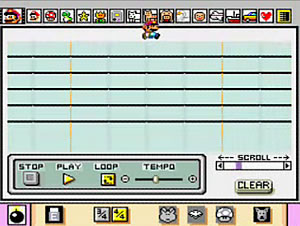 Aaand, just because it wouldn’t be Little Mathletics without some kind of random Mario insanity, I’ve also been searching through Mario Paint composer videos. Here’s the first one I found - it’s someone doing the Meow Mix theme, and it’s absolutely hilariously brilliant. It might actually be a bad one to watch first, because it kind of diminishes the awesomeness of the other videos.
Maybe not, though. Here’s the inevitable Chocolate Rain, a very funny rendition of In Da Club, and a surprisingly passable version of Drop It Like It’s Hot. However, this is probably the best one: John Cage’s 4′33″, which is pictured above. I laughed. A lot. I do find 4′33″ abnormally funny though.
Also, I gather this is kind of old, but a few of the videos were made using this program. It’s called Mario Sequencer, and basically performs the same task as the actual one in Mario Paint, but allows you to do full compositions. And it clearly works well - there’s some great full length songs from Japanese Mario Paint composers, though I’ve got no idea what they’re meant to be. I haven’t played around with it myself yet, but I might give it a shot sometime and post the results. Maybe I’ll use it for my much delayed solo album.
Or not.
———————
I only got my TV back a few hours ago, but I still played a few games last week on the 51cm. I got my review in for Atelier Iris 3, so I went into dB Magazine and picked up a couple more that were sitting in my pigeon hole. I didn’t play the first Stuntman, but I did hear a lot of people talking about it, and how enjoyable it would be if it weren’t so damned frustrating. Stuntman Ignition is probably making those people happy. I say “probably”, because it is still really frustrating in parts, with faultless memorisation playing as much a part as anything. It is possible to get through the levels without hitting every single stunt mark you’re given, but it’s kind of missing the point. I’m not great at it, to be perfectly honest - although I have only been playing it for a few days now - but I generally try to get through on at least 4 out of 5 stars.
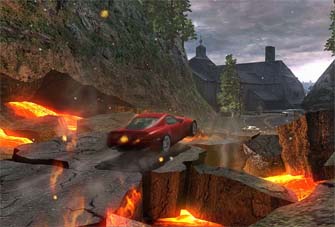 5 starring a level is pretty challenging, because it involves hitting every mark, and keeping a steady flow of stunts going the whole time, whether it be simply going to close to an object or car, or pulling a wheelie on the motorbikes, and so on. If you thought simply memorising where the marks are was hard, then try memorising exactly how close you need to get to that box in order to keep your chain going.
Still, nothing wrong with a good challenge. The game leaves it just short of yelling at the TV territory (hello Spider-Man 3) and well short of controller throwing territory. But it’s going to get annoying by the very end, I can feel it. I think I’d be more open to that if I was playing the 360 version, though - I’m no Achievement whore, as my Gamertag will attest, but I do like to get points if I can, and the addition of badges to the PS2 version just feels like teasing. Who cares about my badges? No one’s going to see them.
It’s weird, really - as a console gamer, this whole online thing is pretty new to me, but there’s already a sense of isolation that comes from playing PS2 games. It’s not even the Achievement thing, it’s just the idea that I’m connected to the people on my Friends List. I’m late to the party with this, I know, but it does surprise me a little.
 So, with that in mind, it’s also surprising that I’ve sunk more time into Stuntman Ignition than I have Blazing Angels 2. It’s probably just the fact that I’m not the biggest fan of the flight sim genre, and so even if Blazing Angels 2 does lean more toward the arcade-y side of things. Despite that, though, I’m really enjoying what I’ve played of it so far.
Except for the vagueness. Man is this game vague at times. There are times where you’ll only have the most basic idea of what to do, and really won’t be able to get through a mission until you’ve given it three or four shots. The game just has a habit of introducing new play mechanics, like the a rear gunman on your plane, or enemy radar coverage, without actually explaining how it all works. I managed to get through the first rear gunman mission by switching to in-cockpit view and flying around randomly.
I don’t know how that worked, but it did.
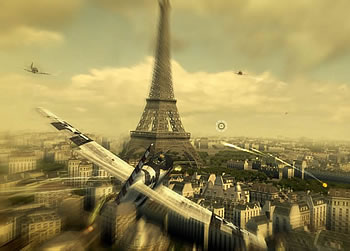 It’s a great looking game, even in SD. The detail in the city levels is really nice, in particular. But the most visually impressive element is the targeting, where the camera follows the enemy plane (or ground unit, or whatever) from around your plane, allowing you to attempt to get it in your sights. It looks incredible, and the fact that you’re still able to pull of some pretty flashy moves with the camera rotating like that - and not crash - is a real highlight of the game. The graphics can be a little too “next-gen” at times, with a whole lot of motion blur and the like, but it’s not really noticeable when you’re playing. In fact, it wasn’t really apparent just how much motion blur there is until I posted that screen to the right.
I’m yet to play much multiplayer, by the way, but I probably will for the easy Achievements. If anyone reading is interesting in jumping on with me and playing some co-op, that would also be fun. Gamertag is down the bottom of the page.
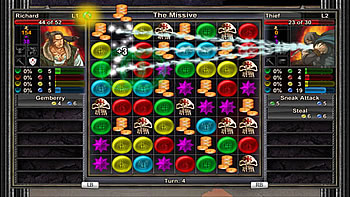 Speaking of multiplayer, I’m mildly stunned at the lack of people playing Puzzle Quest’s versus mode on XBLA. I assumed there would be more people taking advantage of this, but I’m yet to even play a game online. Not that it matters - the single player is fantastic, and it’s really great to have such an absorbing title there as something to just jump into for 20 minutes every now and then. I’m not exactly great at it yet, but I’m a Warlords fan from way back, so the map play is pretty exciting. Back when all I had was an Macintosh LCII (in, embarrassingly, 1996 through 1999) I played that game over and over again, because it was pretty much the only thing that I could play over and over without it losing any of its charm. That and Spaceward Ho!, anyway.
I’ve got another two games in my pigeon hole at the moment - Juiced 2: Hot Import Nights (which, according to Drew from THQ Melbourne, is not a Neil Diamond reference, a fact that disappoints me no end) and Buzz: The Hollywood Quiz. I’m not exactly jazzed about either of them, I’ll be honest, but it is nice to be busy reviewing a whole lot of stuff. Though, I think that’s more to do with the fact that I’m more or less about the only games writer at dB right now, since superstar dance writer and games reviewer Julian Cram is heading off to Melbourne. So, hey, if you’re interested in doing some games reviewing, now’s probably a good time to get in touch with the magazine.
———————
I picked up a bunch of CDs from dB too, but I’m still trying to get through the ones from a few weeks back, so I’m actually trying not to listen to them yet. That said, I did submit to temptation for two of them, and I don’t feel even remotely bad, because we’re talking about albums I’ve been really hanging out for. And, of course, there was the new Radiohead album.
 I don’t know if I had a lot of expectations for In Rainbows. I definitely wasn’t as disappointed by Hail to the Thief as a lot of people seem to have been, but Radiohead seem to be one of those bands that I just never have too many preconceptions about. I was looking forward to hearing the album, but I didn’t want it to sound more like The Bends, or more like Kid A or anything. I just wanted to hear what they had been doing. That strikes me as a pretty good way to go into this sort of thing, especially when the build up to the album was so…idiosyncratic.
It’s pretty safe to say that In Rainbows is probably the first “must hear” release of the year. Not because of it’s quality, but simply because of what it did - levelled the playing field so that there were no promo copies, no leaks, no reviews and no real ideas of what it would be. If you were there downloading your copy at 12am GMT on the 10th, your opinion of it was as important as everyone else’s, including Pitchfork, et al. And that’s pretty strange, but it was really interesting to see that everyone was really excited to share their feelings on it.
Unfortunately, this did seem to mean more than a few rushed opinions. If I had a dollar for every time I’d read “album of the year” or “best Radiohead album ever”, I’d probably have…$24 or so. Still, considering I mostly just stuck to NeoGAF and Stereogum, that’s a lot. That kind of thing is why I tend to take two weeks reviewing something if I can, because there is that real danger of going on first impressions and being entirely too favourable during the honeymoon period, so to speak. See, for example, the first review I ever did - Ribbon Device’s Saturation Day. Not bad, but certainly not awesome. Whoops.
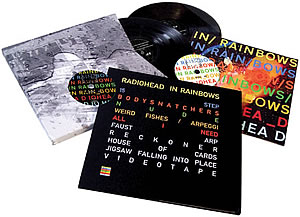 Anyway, I like In Rainbows. It’s not album of the year, or the best thing Radiohead have ever done, but it’s a good album. It feels like what Radiohead should sound like in 2007 - mature, and a little wiser than before. There’s very little of the paranoia that saturated Hail to the Thief, and none of the bleakness and distance of Kid A and Amnesiac. It’s very warm, very beautiful, and actually kind of fun. I can see myself listening to it a lot, because I think it fits a lot more moods than anything else they’ve done, possibly ever.
For the record, I paid 3 pounds for it, which I think is pretty fair. I’ll be buying it on CD anyway, I would think - especially if the retail release has the bonus tracks that come with the discbox. As much as I love Radiohead, I’m not paying 40 pounds for their music.
Although, the temptation of the vinyl is reasonably strong. I’m on a real vinyl kick at the moment, having just inherited 70 or 80 LPs from my aunt, which has significantly boosted my record collection. I’ll be DJing at my 25th in a month or so, which means that I can actually put together a pretty good set, unlike the last time I DJed, when I literally played every record I had. That was still 2 hours or so, but maybe trying to scratch over Loretta Lynn wasn’t the hottest idea I’ve ever had. Oh, damn you alcohol.
Doing that set also means I’m stuck in eBay mode again. I’ve only bought about $25 worth of stuff so far - that’s two awesome Santana LPs, including Abraxas - but it could get ugly. Deep breaths.
By the way, if anyone knows anything about getting into DJing in venues in Adelaide, let me know. I’m not exactly talking about dance clubs or anything, but I could do a pretty mean indie/funk set these days. I promise to lay off the Loretta Lynn, too.
So back to my point, the two albums I did actually listen to are Curses by Future of the Left, and La Cucaracha by Ween. Both, as I said, are albums I’ve been waiting for.
 I’ve been a Ween fan pretty much since I started listening to music that wasn’t on cassettes called Smash Hits Volume Whatever. The Pod blew my mind when I was younger, and probably started me listening to a whole lot of stuff I wouldn’t have even touched otherwise. But, for me, nothing has really been super amazing since 12 Golden Country Greats. Yeah, The Mollusc was cool, and had some good songs, and White Pepper had a few nice moments, and Quebec had some really great stuff on there, but nothing felt as coherent as their earlier work. Shinola was the closest, but that was a rarities collection, and doesn’t count.
But it’s not like I lost faith in them or anything stupid like that - I liked those albums, but I just didn’t love them. And the live Ween stuff that you can find at The Archive is absolutely amazing. I wondered whether it might have been the glossy production of White Pepper and Quebec that I found offputting, but La Cucaracha is pretty shiny too, and the fact is, I really like it.
I’m not even sure why that is yet. I haven’t been able to figure it out, which is why I’m yet to even start writing the review, despite having listened to the album at least 10 times now. I think, possibly, it just feels less restrained than the last two albums - White Pepper in particular. It feels like the band letting loose, especially on the 10 and a half minute Women and Men, which is arguably the most epically psychedelic thing they’ve put on tape since Voodoo Lady on Chocolate and Cheese. I’m going to give it a little more time before I write up the review, but I can say at this point that there’s a lot to like about this album, and not a lot to dislike. Friends could maybe have been left off, because it really doesn’t fit, and I just can’t quite love Your Party as much as other people seem to, but that’s pretty much it.
 Future of the Left is the new band for Mclusky’s Andy Falkous and Jack Egglestone, after Jon Chapple packed up for Melbourne. And the album, Curses, is brilliant. As I’ve been saying to people, along with Chapple’s latest album with his band Shooting at Unarmed Men, it’s enough to make me stop caring that Mclusky broke up.
And that’s really saying something, because I loved me some Mclusky. In my second year of university (well, the six months before I dropped out, anyway) Mclusky Do Dallas was pretty much all I was listening to. I saw the band twice, and each time was incredible. But the albums put out by the two bands that spun off Mclusky are both good enough, and inventive enough, that I honestly wouldn’t want it any other way.
Shooting at Unarmed Men’s Triptych is a great album, and has some tracks that really benefit from the space Chapple gives them, which is something that couldn’t have been done in Mclusky. Similarly, Curses moves in different directions from Mclusky by using synths and playing around with repetition in a way that Mclusky would never have done. And the bass playing of former Jarcrew frontman Kelson Matthais is fantastic - rumbling, fuzzed out and utterly uncompromising from, literally, the first second of the album.
So, really, who could complain? We’re getting two albums that bear traces of where they’ve come from, but still show very obvious signs of progression. It’s great.
———————
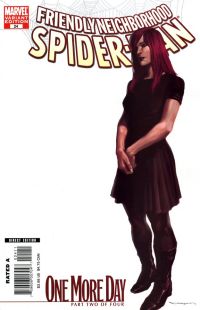 Marvel’s One More Day Spider-Man story arc is utterly bizarre to me. I mean, I’m not the type to whine about something like this and shout about how I won’t be buying the next story arc because they’re not doing it right - I will. Mostly, that’s because I really like where they’re going with Spider-Man, with the whole thing with having Amazing Spider-Man three times a month, with different artists and writers taking on each arc of the title. And some of the teams they have lined up to work on the Brand New Day project, as it’s known, are really exciting.
But One More Day is somewhat less than exciting. It stinks of desperation - a story that isn’t being done because it’s interesting or involving, but rather because its outcome is vital to where the company wants the character to go. The general consensus - and stop reading now if you’re sensitive to spoilers - is that it means the break-up of Peter Parker’s marriage to Mary-Jane, and that Aunt May, who is currently is a coma, will be back and healthy again. Most likely, this will involve some kind of bargain with Marvel’s devil character, Mephisto. I couldn’t care less about that, personally. If they want to reset the character, effectively, that’s fine. I have faith in the teams that will be picking up from where this leaves off.
Like I said, though, the way it’s all coming together just isn’t working. I’m not the greatest fan of J. Michael Straczynski’s plots - though his characterisation is generally pretty good - but this whole arc, so far, has just been muddy and confusing. It feels like the end is justifying the means, and in a comic book, when the means aren’t interesting, or well defined, it becomes immensely trying. It’s boring. The whole arc thus far has felt like padding, and I’m assuming the third book will be much the same, before eventually something brings it all home in the final book in November. There’s no resonance to the actions of the characters. And that’s just lazy.
Joe Quesada’s art could have been the one thing that made it worth reading. He’s a fine artist, and while I didn’t really like the overly-stylised look of the first book because it made the more “dramatic” scenes seem trite, the splash page for this current issue made me wonder whether things might have picked up. It really is one of the greatest pieces of Spider-Man art in some time. The webbing is just beautiful, and the posing is really masterful. The Dr. Strange stuff that follows is great too, but the freakishly over rendered musculature from there is horrible, and the layouts seem to lose any trace of the dynamism of the first few pages. And the constant narrowing of the eyes on Spider-Man’s mask? Bleh, no. Isn’t there another way to show emotion without resorting to that? It looks terrible.
Some of the blame for the characters, at least, must fall on inker Danny Miki, who just isn’t a good match for Quesada. His work is too scratchy and thin, and while that would certainly work with some pencillers, it only serves to intensify the problems with Quesada’s anatomy.
So, I’m going to stay with it through the next two issues, but I really can’t wait for the new teams to take over so all this can be left behind. Dan Slott, of She-Hulk and Avengers: The Initiative, and Civil War penciller Steve McNiven are kicking it off, which sounds like it’s going to be great.
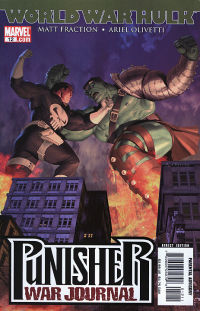 Speaking of comic redemption, I was about to drop Punisher War Journal from my pick-up list. For months now, it’s been ridiculously boring - the recent Hatemonger story arc went for five issues, when it really should have been concluded in two. It’s a pity, because the first five issues of the series were brilliant, with the kind of humour and sharp dialogue you’d expect from Matt Fraction. Somewhere along the line, this all kind of disappeared, and we were left with something that felt totally aimless.
The same thing happened with Ariel Olivetti’s art, which was really well suited to the more urban environments of the first three issues, as well as his fantastic rendition of Times Square in the fifth issue. By the end of the Hatemonger storyline, though, it was welcome to have a fill-in artist, just because it was all beginning to look a little to smooth and stylised, and bland, which is a word I never thought I’d use to describe Ollivetti.
Issue 12 was the issue this comic needed. The artwork feels more suited to this kind of scenario, and the range of emotions on every one of the character’s faces is spot on. The fight scenes are equally great, with a real sense of impact, though the sense of movement can sometimes feel a little stilted. But it’s the dialogue that’s really returned this issue to form - Frank and Clarke discuss whether She-Hulk has an “I’m-filled-with-self-loathing-and-I’m-going-to-sleep-with-guys-below-my-station thing going on” while in the middle of a warzone, for example. Also, there’s a gun that shoots swords. Yeah.
I’m still not totally filled with excitement at the idea of the Punisher taking on Kraven’s son in upcoming issues, but at least there’s some definite hope that they’ll be worth reading now.
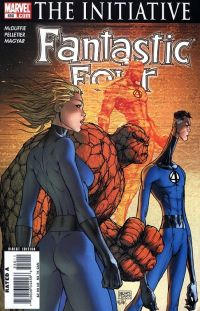 Leaving aside the awful, awful Michael Turner covers, Dwayne McDuffie’s run on Fantastic Four has been very readable, especially after Straczynski’s bland, lacklustre work. It looks like the Turner covers are staying until the new creative team starts, which is definitely a reason to look forward to that, but it will be a pity to see McDuffie move on, because it would have been interesting to see what he could have done with the team with more time.
There’s a few more issues to go, but this arc has felt a little rushed, especially issue 550, which hammers through plot points and cameos at a rate of knots. It makes more sense the second and third times through, but this and the last issue have both had that feeling - like it was maybe planned to take more issues, before the exact length of McDuffie’s run was cemented. And now, with one more arc to get through before Mark Millar and Bryan Hitch take over (which is really exciting, by the way).
The art, fortunately, is beautiful. Paul Pelletier’s work can feel a little cramped in the more cosmic scenes, but his individual character work is nice, and shows a lot of subtle control. He draws a really great Thing, and luckily, Rick Maygar inks a really great thing, which is most important with that character.
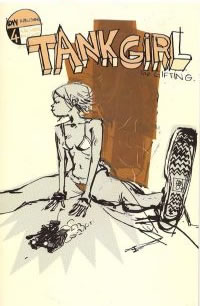 Finally, Tank Girl: The Gifting #4 is everything you hoped for. It’s hilarious, and has some of the most creative uses of swear words ever in print. If anyone ever tried to convince you that swearing isn’t funny, this is the book to show them. The poo and fart jokes can get a little too much at times, but they’re mostly just in one of the stories in this book, and for the rest of the time Alan Martin is in fine form. It’s irreverent and often pretty stupid, but God it’s fun.
And the art! Ashley Wood is magnificent. And Australian. Honestly, I don’t even want to say too much about it, because you really should see it out yourself. If you missed the four part series, it will undoubtedly be out in trade paperback form at some point in the future.
But the really good news is that Wood and Martin are working on a new four part series, with a more consistent narrative (though probably not a more coherent one). Tank Girl: The Royal Escape is set for sometime in 2008, I believe. I can wait. I’ve also heard that Martin is working on a series called Tank Girl: Carioca with 2000AD legend Mike McMahon due sometime in the middle of 2008. This strikes me as being pretty exciting, assuming it’s true.
By the way, IDW Publishing - how about a poster? I would absolutely buy a poster of any of the full page pin-ups from the back of issue 4. I heard there were promo posters for the series before its release, but I hold absolutely no hope of ever seeing one of them, let alone owning one. Still, if someone wants to prove me wrong by sending one my way, the contact details are up the top of the page. It’s my birthday soon, you know.
———————
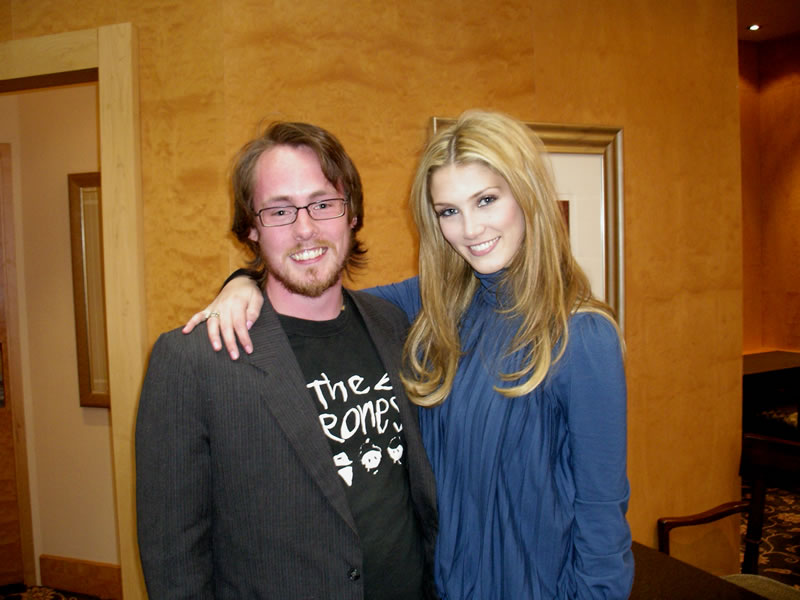
Once again with the lots of writing, eh? Nevermind. Oh - almost forgot the big celebrity surprise! Last Friday, I met Australian pop star and former Neighbours actress Delta Goodrem. There’s no real exciting story to go along with that statement - I showed up the hotel, and the Sony rep gave me some coffee and water and then I spoke to her - but she was really, genuinely lovely. Everything she did while we were talking just made it seem like she was actually happy to be talking with me, which made it a real pleasure. I’m obviously not the target audience for her music or anything, but Delta Goodrem is still Delta Goodrem, and I admit to being a little starstruck. And of course, I pulled the really professional trick of asking for a photo. Click for full-sized horror - or mostly full sized, anyway. No one needs to have to deal with 2400×1800 pixels of me. However, apparently the photo will be in an upcoming issue of dB Magazine, so you can cut it out and put it on your fridge if you want. Probably good for losing weight or something, right?
Actually, while I’m doing the whole pictures-of-me thing, I went to a party on Saturday night dressed as one of my childhood heroes. Keen fans unite!
I’ll be back next week.
The Little Mathletics Shipping Report (30 September - 6 October)
0 Comments Published by alistairw October 10th, 2007 in Shipping ReportThe Shipping Report continues - albeit, a day or so late. There are various reasons for this, but they’re not really worth going into. Anyway, after last week’s mammoth début, I’m probably going to keep it to a more manageable level for future columns, though it really depends on what’s actually been happening. This week? Well, not much, really, though there’s a few interesting comic releases, and the finale of Kaizo Mario to touch on, plus a few other Mario hack goodies.
The site is behaving better now, which means that you can leave comments and so forth. I’m not hating the big chunk of text look, to be honest, so we might continue with that for a little while, or at least until someone tells me not to do it anymore. Why did it start working again? I don’t know. What can I do to make sure that doesn’t happen again? I don’t know. Why does technology hate me? God knows.
On with things and such.
——-
Seeing as how this is meant to be a workblog of sorts, I though it might be a laugh if we started by actually talking briefly about something that I’ve been working on. The Game Developer Top 20 Publishers 2007 report is over 120 pages and almost 20,000 words of in depth analysis of this year’s most successful games publishers. Graphs, tables, peer response - we got it all. And more!
More?! Yes, more! We’ve got responses from people who have worked with these companies, as well as analysis of the companies that didn’t even make the top 20. Plus, there’s financial information up the wazoo. It’s “an unprecedented level of data into how major game companies are currently faring”.
To be serious for a second, it is a pretty interesting piece of work, if I do say so myself. I owe a big thanks to the people who worked on collating and gathering the information for it. I don’t want to say anything about what’s actually in there, because Gamasutra and GameSetWatch have talked about it in detail and it’s not really my place, but I’m proud of it, which is a nice feeling. There was even a thread on NeoGAF about it, which made me go all shy and not say anything. Anyways, buy a copy for the low low price of just US$2,995.00 and help keep me in a job.
——-
Let’s then move onto where we left off last time around with Kaizo Mario - the first half of the final level had just been posted, and we were waiting on the final half. Well, it’s finally here, and despite not being as outrageously flashy as some people might have expected, it’s a really solid effort, and once again shows exactly how much thought has been put into all this. For the most part, this video focuses on the end boss battle, which is really brilliantly timed.
YouTube is, as always, really annoying to get good screen grabs from, and I’m not about to try and make my way through this level just to take a screen myself, but I think you can probably make out what’s happening here. The Reznor (which are the dinosaurs on the spinning platforms) are surrounded by a series of those snapping flowers, and Mario is boxed in by the plunging spikes, and the rising lava. It’s immensely claustrophobic, and clearly a real struggle to even manage not to get hit by the Reznor’s fireballs.
In order to actually pass the level, you’d need to get over to the other side of the boxed out area and hit a P-block, then collect the coins that the snapping flowers turn into to give you space and the chance to actually hit the Reznor. The final moment, where the timing needs to be absolutely perfect is brilliant. Because the Reznor spin, the last one is over the other side of the area when the spikes are up the top and the lava is right down the bottom - the actual attack is so split-second as to actually be a bit nerve wracking. It’s a fittingly nail-biting end to a great series of videos.
It seems that there is also a series of videos of someone doing a tool-assisted speedrun of the first set of Kaizo Mario levels. It’s interesting to see someone move through the levels with confidence, but it ultimately misses the point of the whole thing: it’s appealing because the levels are so hard, and the player isn’t perfect. They could easily have just shown the successful run that the player makes through the levels, but that wouldn’t have illustrated the genius of the design anywhere near as well. You really need to see how easy it is to fail to see the kind of accuracy in timing and jumping ability you need to be able to play through it properly. The speedrun is, for that reason, actually really boring.
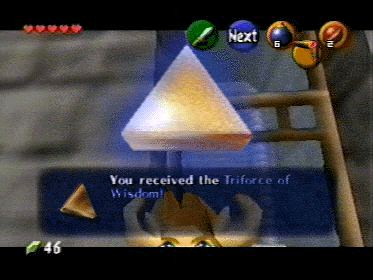 I ended up spending a little while checking out some more Super Mario World hacks, in the end. There’s some pretty interesting stuff floating around on YouTube, so I’ll try to get through the most interesting videos over the coming weeks. I thought I’d start with some pretty simple stuff this week though - instead of looking at full on game changing hacks, I wanted to focus on the hacks that add just one or two levels to the existing map, and then make claims about finding “new secrets”, or something of that sort. I can kind of understand why people do this, to be honest, or at least why people are interested in watching it, and questioning whether or not it might be true. I mean, obviously it’s not true, but it’s similar to the obsession people have with Zelda: Ocarina of Time’s non-existent Triforce - it’s the question of whether or not we know absolutely everything there is to know about our favourite things, or whether we might still be able to squeeze one last moment of amazement out of it.
I remember years ago finding out that there’s a secret track before the first track (in the pre-gap, if you want to be technical about it) on UNKLE’s Psyence Fiction. It really surprised me that there could have been something extra in this CD that I knew so well. Hell, I had the exact same feeling literally just then when I found out that there’s something in the pre-gap of Jimmy Smith’s Root Down album - I couldn’t even count how many times I’ve listened to that without knowing about it. It’s not very interesting (just Smith introducing the track Sag Shootin’ His Arrow), but it’s something.
For that same reason, wouldn’t it be amazing if there was an extra level in Mario World? Just knowing that’s there is something new to experience in something you really love, no matter how small that extra moment is?
One of the focus points for a lot of people seems to be the island just above the Top Secret Area. That’s not really surprising, seeing as how it is in an obvious location, without anything actually happening there - sort of like the island in the first level of GoldenEye, though that actually did have an importance, before its related mission goals were cut. As far as I know, the island in question in Mario World is just there to fill out the map, and always has been. Of course, that doesn’t stop people from wanting to find a way to get from the Top Secret Area to the island, and creating their own ways to do so - some of which are more interesting than others.
This effort is one of the better ones. The level is reasonably well designed, especially in regards to the need to carry the key almost all the way back to the beginning of the level. It’s not easy - if you’re small, at least - but it seems achievable. I assume that’s the goal, actually: to make it challenging, but possible to do on your first run through. It could have done without the glitched grey Spineys, though. That’s not a good look.
This level uses the same ideas - a hidden pipe in the Top Secret Area - but adds an extra power-up in the new level, which is an interesting idea, but doesn’t really turn out so great. The “Laser Suit” is seemingly just an altered feather, but it looks lame, and the lasers it shoots are at kind of a weird height. They look like they should be coming from lower on Mario’s body. I’m guessing that’s just a sign that they’re using part of the code from a fire flower, maybe? It’s actually kind of weird that more people haven’t tried messing with the power-ups in the game, now that I think about it.
There’s one that just expands on the Top Secret Area, but it’s pretty badly done. It’s got all the hallmarks of an average hack - too many bonuses, and too much linearity in the design. It looks incredibly boring, and doesn’t seem to take any effort whatsoever to get through.
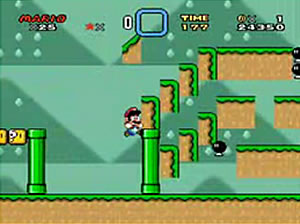 Finally, I think this one is my favourite, simply due to its utter disregard for anything even approaching proper level design and believable secrets. The hidden level is, apparently, on the moon in Star Road, and is accessible through Star World 1 - a level that already has a secret exit, but nevermind. On top of that, the exit is accessed by falling through the floor, which seems a little out of sync with the design in Mario World.
It’s the level itself which is the real selling point, though. As well as being completely without challenge, as with the previous level discussed, it’s glitched in an utterly pointless fashion. Enemies are rendered unrecognisable, and the world’s building blocks are scattered around with disregard for their proper placement. For some reason, though, I think the best bit is the five seconds of emptiness before the player crosses the finish-line. It’s really quite awesomely surreal, in a way. Just look out for the horrible music dubbed over the video - it’s that really awful Bloodhound Gang song that I can’t remember the name of.
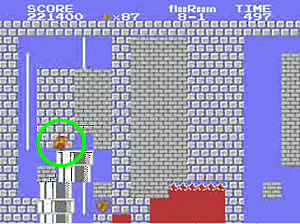
Finally, glitching in a much more interesting and inventive manner are the two Super Mario Bros. hack videos put up by fellow CMP writer Matt “Fort90″ Hawkins a few months back - I must have missed them, but I’m glad I stumbled onto them, because they’re absolutely amazing. God knows where Matt got the videos. There’s no doubt that they’re tool assisted, incidentally. The player uses too many glitches to get through (wall jumps, walking through walls, other weird stuff I don’t even understand) for it to be done straight.
The first of the videos, or what I think must be the first, is called Hard Relay Mario. SMB is a game that has been utterly dissected by numerous people, and this takes advantage of all of that knowledge - all the glitches mentioned above are used constantly. I’ve circled Mario in the picture above. He’s currently in the middle of glitching through a wall.
There’s a lot of stuff going on with the end of level flagpole that I really can’t get my head around as well. A good deal of the time, the player will have to jump around it, over it, or even through it, before actually finishing the level. But unlike the Kaizo Mario tool-assisted run, the sheer effortlessness of this run is what really makes it so amazing. I’m not sure if it’s actually a speedrun, but the player is moving quickly enough, and with enough idea of exactly what to do next that it may as well be. It’s just that feeling of looking at someone doing that and thinking, ‘That is something I could never ever contemplate doing’.
The finale - sort of - is pretty interesting too, not because it exploits the game in the same way that the rest of Hard Relay does, but because it just looks so broken and bizarre. It’s far enough removed from what we understand to be SMB that it does kind of have that feeling of bringing something new to something we love, though not in the sense that it’s something you might actually want to try, mind you. Because, you know, you’ve never actually had to deal with avoiding spikes while travelling on platforms while attempting to kill a floating Bowser. Because that would be really actually rather hard.
There are a couple more levels afterwards, one of which brings the whole wall jumping mechanism to a ridiculous extreme. That one’s worth a look. The very final moment just reprises the Bowser battle, for some reason.
But while it relies on glitches to complete, the game is actually fairly normal looking, on the whole. Not so for the secod video, Falling Mario, which just breaks open the game, and abuses everything within it, from purposely creating buggy graphics, to replacing the Hammer Bros. sprite with Princess Toadstool. It’s almost some kind of bizarre philosophical statement, with Mario dying at the end of every world by jumping into a bottomless pit after hitting the flag, noting:
 “OH GOD! I WONDER HOW MANY TIMES I HAVE FALLEN!”
No doubt there’s something in that (does Mario have an innate knowledge of everyone of his own deaths?) but maybe it’s not the point, so I probably should avoid putting words into the designer’s mouth. Instead, let’s just look at this picture - again with Mario circled - and marvel at how utterly and stupidly broken it looks. Then watch the video, and realise that it’s all put together with the utmost care; there’s one very linear path in there, and it’s designed down to the merest detail. And then feel a bit confused about the very odd ending, which I won’t spoil other than to say that it’s like some kind of crazy fan fiction. Or something.
My favourite thing about Falling Mario is the music. Some of the notes seem to have been replaced with minor scale equivalents, which gives the whole thing this strange melancholic feel. It’s pretty cool. If I could find the hack anywhere - I’ve tried, and I can’t - I’d rip some of the audio and post it here. For now, I guess you’ll just have to watch the video.
Incidentally, I’m guessing these are designed by the same person who did the slightly more well known Super Mario Air. It’s reasonably easy to get a hold of, and there’s a tool assisted speedrun of it on YouTube, but I wouldn’t recommend hunting down a copy of the ROM unless you understand a whole lot about Super Mario Bros. Like the two videos above, it breaks the game in enough ways that you really have to have an intimate knowledge of how to do that yourself to even get through the first level. Weird stuff.
——-
I’m not really going to talk about what I’ve been playing this week, mostly because I talked about Atelier Iris 3 last time, and aside from a little bit of Project Gotham 3, that’s all I’ve been doing this week. I’m heading into dB Magazine to pick up Blazing Angels 2 for 360 tomorrow, though, so I should be able to talk about that a little over the weekend. I’m also considering buying Puzzle Quest on Xbox Live Arcade, but that might have to wait until I get my TV back, because playing 360 on a tiny SD TV is really weird for me now. I feel like such an elitist saying that, but it’s obvious that the console really is designed for HDTVs once you’ve seen it on one.
As long as I have it back by the time Orange Box comes out in Australia on the 18th, I’ll be happy. With all the talk of Phong shading in Team Fortress 2, and added HDR lighting and updated textures in Half-Life 2, I don’t really want to have to squint to make sense of it.
——-
Music-wise it’s been much the same as last week too, though there has also much Elliott Smith listening, again, for reasons that don’t really need to be touched upon. It is worth mentioning, however, that I missed The Brels CD launch for that same reason, and feel like a bit of a jerk for doing so. Sorry guys!
——-
It must have been Steve Gerber Revisionist Week at Marvel. Or, depending on your feelings on the matter, Screw Over Steve Gerber Week. The two books that I picked up are both new writers’ takes on Gerber characters from the ’70s, Howard the Duck and Omega the Unknown. There’s a big issue with character ownership that surrounds these titles, and, above all that, a fairly simple issue of courtesy: should Marvel have approached Gerber to write the books rather than handing them off to new people?
The two books both bring slightly different problems to the board in regards to that question. Omega, written by Fortress of Solitude author Jonathan Lethem, was given the green light after Lethem approached Marvel with the idea. He’s a self-confessed fan of Gerber’s original 1976 10 issue (unfinished) series, and wanted to bring it to a new audience. So should Marvel have optioned the series to Gerber before giving Lethem the go-ahead? I’m not sure there’s an easy answer there.
Howard the Duck is written by Ty Templeton this time around. Gerber wrote this series the last time it was revived, in 2001. Should he have been offered this latest series, rather than Templeton? Templeton’s got the pedigree to be working on something like this: he’s a huge fan of the character, and his work has certainly shown the kind of absurdity required for the project. But I think this is much clearer than the Omega issue - Gerber definitely should have had first say on this.
Obviously, there are a lot of people who feel very strongly about all this. Gerber is one of the most beloved writers in comics, both for his work in the past, and the excellent work that he continues to put out. Mark Andrew over at the very wonderful Comics Should Be Good blog is talking about things in the most level headed way I’ve read so far, although I really must disagree with his decision to boycott the two books. I think, as important as it is to support creators like Gerber win the recognition they deserve - because, really, a little header that credits him at the start of the book is a pretty token gesture - the implications of not supporting the work of people like Lethem and penciller Farel Dalrymple on Omega is also something that shouldn’t be ignored. This book is so out of the ordinary in terms of art and writing for Marvel that people should be putting their hands up and supporting it so that we can foster new and interesting talent in the mainstream.
And, hell, I like the book. Visually, it’s absolutely stunning. Dalrymple is great; really expressive, really stylised, delightfully understated, and his action isn’t half bad either. There is one page where I thought his shading for shadows came off as a little overbearing, but that’s one page out of 22, and the rest is gorgeous. I found Paul Hornschemeier’s colours to be a little too bland in some of the shots set inside the hospital. For the most part though - especially in the outdoors settings - they work really well with the art.
I think the story is going to work better in a graphic novel format, however. The first issue doesn’t really give a lot of clues as to where Lethem is going to take the story, and even though you’d assume he’s going to follow the original series pretty closely, there’s still a feeling that maybe a little more should have been given to the readers. I’m fine with that, and I’ll be picking up the whole series if it continues at this level, but I can see some readers tuning out at a perceived lack of actual action.
But other than that I can’t fault it. I freely admit that I wanted to like this right from the beginning, but it’s nice not to be disappointed all the same. Lethem’s scripting is terrific - natural when it needs to be, and unnerving when that’s required too - and I’d really like to see more of him in comics after this is all wrapped up.
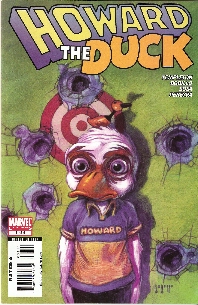 Oddly enough, Howard the Duck’s biggest problems are in this department. It’s not so much Templeton’s dialogue, which is actually crisp and well timed and features the kind of effortless characterisation he does so well, but with the overall pacing of the book. The second half feels like five pages stretched out to 11, and by the end of it, there’s just a feeling that it was all a bit messy. That’s not a good sign for a four issue series.
Juan Bobillo’s pencils are nice, however. They’re a bit uneven at times with some of the human characters, but the world-weariness in the design and expressions for Howard are fantastic. It’s a pity, then, that Marcelo Sosa’s inking is so heavy handed. While it works on Howard, the more detailed scenes are really oppressive, which contrasts horribly with Bobillo’s cartoony style.
I’ll pick up the next issue, but I’m really not feeling it. I want to love it, because I love Templeton’s work, and I love what Howard brings to Marvel’s portfolio, but it just comes across as too unrefined, and occasionally a little tired, too.
——-
Hmm, so again, I’ve actually written about ten times what I intended to, but nevermind. I wanted to talk about the frustratingly stupid new translation for Chrono Trigger, but time is getting away from me. I’ll get the hang of this eventually. Just know that pedantic wooden literalism does not equal better. Sheesh.
Next week’s will be on time, guaranteed, or your money back. There might even be a very special shock surprise celebrity photo to go along with it. But more on that next time!
The Little Mathletics Shipping Report (23-29 September)
0 Comments Published by alistairw September 29th, 2007 in Shipping ReportOh, hello there. It’s been brought to my attention that I am, in fact, a very lousy blogger, and can’t even keep up with blogging about what I’m doing for work. This, I admit, is very true. I am a horrible blogger. So, in order to try and work around that a little, I’m starting this new column/regular occurrence: the weekly Little Mathletics Shipping Report. In this regular feature, I’ll be talking about, basically, what I’ve been up to for the week; what I’ve been listening to, reading, watching, playing, and so forth.
It should be up every week around this time, barring massive life affecting issues, ie. general weekend lethargy and blatant laziness.
So, come with us now upon the good ship Littlemaths, as we take a gander at this weeks Little Mathletics Shipping Report. You’ll have to excuse the fact that this is, in fact, a very big block of text right on the front page, but I don’t seem to be able to post breaks, as it gives me a 404 error. For the same reason, you can’t post comments at the moment. If anyone’s got any ideas as to what might be causing this little problem, get in touch! I’m confused and a little frustrated.
———————
I’ve been watching a lot of YouTube stuff this week. The first thing that caught my eye was Jonathan Ross’ amazing BBC 4 documentary on Steve Ditko, co-creator of Spider-Man and Dr. Strange for Marvel. Dtiko’s work on those two titles is incredible - Ross, in an article for the Guardian, notes that his characters have a sense of “grace and poise and finesse rather than brutal strength and power”. His hands, in particular, are unmatched. Check out some of the early Spider-Man, because his posing when Spider-Man is shooting webs is just fantastic; the hands are so full of life, and Spidey’s movement through New York’s skyline is just brilliantly fluid. His work on Dr. Strange is just as expressive, but it’s the visions of other dimensions that earned the title its band of followers in the late ’60s - it’s supreme psychedelia of the highest and most creative order.
Ditko left Marvel after only 38 issues of Spider-Man in 1967, and went to work for Charlton, a small publishing house where he’d got his start years earlier. The reason, or rather, reasons, he left are often what confuses people: why would an artist and plotter on one of the most successful books just up and leave? 38 issues might seem like a long time now, but consider, for example, Jack Kirby’s 100 plus issues on Fantastic Four. Ditko’s move was seen as pretty strange (no pun intended). But the reasons are pretty reasonable: he was unfulfilled morally by the Marvel work, and resented Stan Lee’s liberal inserts into his storylines when Lee would script them, and he was concerned about the treatment of major artists at Marvel as well. Kirby himself would leave for DC for that very reason two years later.
While at Charlton he created, amongst other characters, The Question, an objectivist vigilante who punished those who stepped onto the side of wrong. He followed this up the same year with Mr. A in the alternative book Witzend, which took his Randian philsophies to an even more extreme level. As the splash page for one issue said:
“Make your choice! No one can do it for you! You uphold the good or you join the evil! It’s either one…or the other!”
It’s heady stuff, and it put off a lot of Ditko’s fans who, at the time, were fairly liberal late teens. Ditko later went on to work for DC, where he created The Creeper, and The Hawk and The Dove (a fairly stinging attack on liberality and the inaction that Ditko associated with it), and eventually returned to Marvel for a time in 1979. From there, he freelanced his work to various companies, though he never really worked on anything as high profile as Spider-Man. According to various people working with him at the time, however, this was more a case of personal choice rather than anything else; attempts to even get him to feature Spider-Man or Dr. Strange in cameo parts in Marvel comics he was pencilling would inevitably just end in a polite declination.
 Actually, there was one more important character that wasn’t mentioned in Ross’ documentary: Squirrel Girl, who’s one of my personal favourites. Ditko plotted the story she was featured in - an issue of Marvel Super Heroes in 1992, and pulp writer Will Murray scripted it. In it, Iron Man meets an up and coming super hero named Squirrel Girl who…uh…has the ability to control squirrels. She then goes on to defeat Dr. Doom. Classic stuff. She’s been written better since then - Great Lakes Initiative/Deadpool Summer Fun from a few months back was absolutely brilliant - and she’s hardly a typical Ditko character, but still.
Anyway, Ditko is probably most notable these days for what most people perceive as some kind of hermitic behaviour. There’s no more than four photographs of him in the public space, and only one known voice recording of him. He hasn’t done an interview since 1965, although he has written pieces for The Comics fanzine. It’s not that he’s a hermit, though - he’s just an intensely private person who believes in letting his work speak for him, which is understandable.
That brings us to the point of Ross’ documentary, then: he essentially went off in search of Ditko, while trying to tell the Ditko story along the way, speaking to John Romita Sr., Neil Gaiman, Joe Quesada, Ralph Macchio, Alan Moore, Mark Millar, Stan Lee and others to get their views and input. He does meet Ditko, in the end (taking Gaiman along with him as his “sidekick”) simply by going and knocking on the door of his office, though Ditko, predictably, declines to be interviewed or photographed. What makes the documentary so fantastic, however, is Ross’ own passion for the subject - he’s a self-admitted Ditko fanboy, and it shows in the fevour with which he brings the story together.
It’s easy to recommend this, but unfortunately it seems to have been taken down from YouTube. I gather it might appear on some kind of BBC online service sometime soon, and will no doubt get a commercial release of some sort. If you’ve got any interest in comics, it’s worth keeping an eye out for it, and if I hear anything, or see it around again, I’ll make sure to post it.
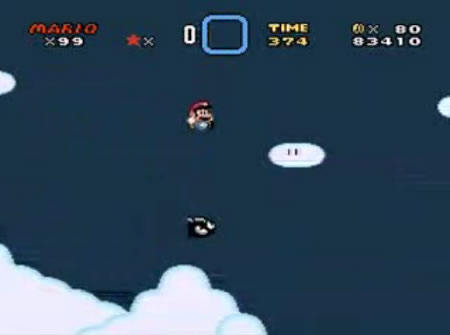 I’ve been watching a lot of Kaizo Mario as well. Literally, the name is “Making my friend play through my own Mario hack”, but it seems to be shortened to simply Kaizo (hack) most of the time. Or, as the YouTube video lists it: Asshole Mario. Which is very appropriate, really. This isn’t your average Super Mario World hack (by which I guess I mean they haven’t swapped out the Mario sprite for a KKK member or a Nazi). I think they’re made by R. Kiba, though I have very little knowledge of Japanese so I’m probably wrong.
It is quite possibly the most fiendishly put together set of levels I’ve come across - there’s only one way to get through these levels, and the timing and problem solving involved in playing through them is simply astounding. And the patience. Hoo boy. Just watching it makes me twitchy at times. There are moments you just have to laugh, when, after completing an intensely difficult section, the player (whose name, I believe, is T. Takemoto) will die because there was an invisible coin block just at the angle he was trying to jump. It’s devious, and must have been frustrating as hell for the guy playing through it. I probably would have thrown my controller across the room, and I’m not the sort to do that at all.
Like I said, though, it’s actually pretty funny, mostly because it is so devious. There’s a real humour in the ridiculousness of the level design - these are levels that I wouldn’t even attempt, and I like to think I’m at least reasonably good at SMW. It’s achievable, though, even without doing a tool assisted run, and that’s a big part of the appeal of these videos, I think: the player is fallible, and screws up even the most simple things some times. And he dies a lot. There are some levels, according to the end sequence, where he dies well over 100 times.
Actually, the editing on these videos is really great - it shows a lot of unsuccessful attempts, but it keeps the action moving forward too. There’s also a number of times that just show death after death for a few seconds. It’s really well done, and shows a good grasp of comic timing, even if the audio does tend to get a little janky at times.
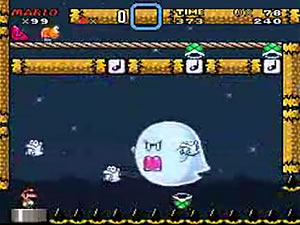 The sequel is where the real excitement is, though. The difficulty is ramped up immensely, but the inventiveness of the design is as well - the first level, in particular, is brilliant, though the opening sequence, which parodies that of the first game by allowing Mario to actually die, is a real highlight too. But the Big Boo fight at the end of stage 4 takes the cake. If the difficulty was toned down a touch, it could be something right out of Yoshi’s Island (which, personally, I’ve always felt is the most creative 2D Mario game by far). I’d love to see Kiba attempt to design a hack that’s a little more friendly, because he has a real flair for creative, inventive level design. His grasp of how the game works is exceptional, as well. The timing required in some sections, and the angles at which some jumps have to be made shows that.
The first part of the last level of Kaizo Mario 2 - or Asshole Mario 2, if you prefer - has only just been put up yesterday. Man was that worth the wait though. The moment just before the half-way mark is incredible, and I can only imagine how it must have felt to finally reach that half-way tape. I’m really looking forward to seeing what the rest of the level is like - I believe the original file is about 23 minutes long, though I’ll be damned if I can figure out how to download it from the Japanese site it’s on. Nevermind. I’ll probably say a few words about it next week, anyway, assuming it’s up by then.
———————
I’ve been reviewing a few games this week. The first was Surf’s Up for PS2, based on the movie which is out or is coming out or something. It looks so bland that I honestly feel like it’s already come and gone, though I might be getting it confused with Happy Feet. Meh. Anyway, it’s been a while since I’ve played a surfing game - probably since California Games in the late ’80s, to be honest. Surf’s Up, as it turns out, is surprisingly competent, for what it is: a kid’s game. I finished it in less than two hours. Still, it’s not without some merit, and I can imagine kids having a ball with it. The play mechanics are more or less based on that Tony Hawk type design: complete level goals, score points by completing tricks, etc. There’s an SSX style power-up bar to go along with it too, which can allow you to score eight times the amount of points in one special trick, but this is kind of what lets the game down. Essentially, it all boils down to repeating the same trick over and over again, since there’s no score-based punishment for doing so, until you fill the meter. Then throw out a few of the super tricks, then build up the meter again…you get the idea.
It often takes a little while to get my head around kid’s games. I can’t quite imagine what I would have thought of this game when I was younger; I grew up playing Thexder and Baal and games like that. They sure as hell weren’t easy enough to complete in two hours. In fact, I’ve never even come close to finishing them. It’s simple enough to say, ‘Well, this game is clearly aged at kids under 10′, or something like that, but I was playing those games - and having a blast - when I was eight. I mean, if I was starting off playing games nowadays, what’s to say I would actually want to play something like Surf’s Up? Maybe I’d rather play Gradius V. I’d probably be pretty crappy at it (actually, I am pretty crappy at it, but that’s not the point) but I’m sure I’d enjoy trying to do it. That’s why I kept playing Xenon 2 and Carrier Command.
I find kid’s games absolutely fascinating, though. I really like reviewing them, because it is really interesting to have to put myself in a different mindset. In this case, because it was for dB Magazine, I think it’s important to write towards parents - dB’s not really the kind of thing that would be read by the target audience for this game. And there’s no point writing towards a typical gamer audience, because they’re not the people who would even think about picking this game up. So it’s parents then, and, to be honest, I couldn’t see any reason not to say that I consider this a pretty competent children’s title. It’s certainly not the worst kid’s game I’ve ever played, and it’s fairly cheap. So, parents could do worse, I guess.
So I got that review written up pretty quickly, which allowed me to move onto the second game I’m reviewing: Atelier Iris 3: Grand Phantasm. I reviewed the second game last year, and wrote a relatively glowing piece about it. It was flawed - the story was pretty crappy, and the graphics are Dreamcast quality for the most part. But it was a lot of fun. I kinda felt a bit weird about that review afterwards though, and I wondered whether I’d actually been too glowing. Having played through the third one for about 10 hours now, I’m less worried. I know a lot of people consider the series the very image of the average and predictable JRPG, but I think that’s giving the game a lot less credit than it deserves. There’s a lot of really interesting things about it.
As with the second game, Grand Phantasm’s battle system is really engaging. It’s maybe not quite as exciting as its predecessor, but it’s still an interesting take on the genre, especially once you’re able to push enemy attacks back with regular weapons. Of course, as with the rest of the series, weapons are upgraded using alchemy. Again, the way it’s used in this game isn’t quite as interesting as the alchemy system in Azoth of Destiny, but it’s not too bad, and is infinitely more interesting than simply buying objects.
The story progression is well done this time around, too. The main characters are Raiders working for the local guild, which basically means that they’re just odd-job people, it seems. So, like the hunting system in Final Fantasy XII, you’re able to select quests for money and reputation points. Once you’ve built up enough, you move onto the next Raider level, and the story progresses. It feels a lot more freeform than the other Atelier Iris games - even if it’s really not.
The quests and missions take place around the town, or in areas accessed through gateways around the town. There’s five of these areas, called Alterworlds, and they’re all actually of a pretty reasonable size. The most interesting aspect of them is the fact that there’s a time limit within them, meaning there’s a kind of urgency to your exploration through those worlds.
The storyline is pretty bland, despite the good progression, and the character designs are…a little on the fan service-y side. Check out the differences between Viese from the second game and Iris from this one (image composition by of Durante on GAF). They’re both main female leads, but, wow. Pretty blatantly sexed up. Wait until you see Nell the bunny-girl, one of the supporting cast, or Eva who owns the town bar. I don’t even want to put pictures up here. It’s forgiveable, though, because the pacing of the game is really spot on - things move fast enough to keep your attention, and the quest system provides plenty of little tasks.
So, I don’t know; I haven’t finished it yet, so it might get a little old by the time I do, but I’m digging it so far, and I’m liking the fact that it’s pretty easy to just get 20 minutes of play out of it. The review is due in about a week and a half, so we’ll see how I’m feeling then, and I’ll throw in a quick update.
So, is that all I’ve been playing? Yep, it is. No Halo 3 here. I’m not much of a Halo fan, to be brutally honest. It’s a fun series, and is an absolute blast in co-op, but I really don’t dig the competitive multiplayer. And yes, before you ask, it is because I suck at it. I didn’t even play the beta, for that reason. So, I’ll buy it eventually, but it’s really not a priority. I’ll probably use the money I would have spent on Halo 3 on the Orange Box, because that’s got me excited as all hell. I’ve never played Half-Life 2 - I know, I know - but I can’t imagine getting a better chance than this. Plus I get Episode 1 and 2, Portal and Team Fortress 2? How could anyone resist? Roll on October 18!
Also, my HDTV is gone for repairs at the moment, so I don’t even have the 360 plugged in. Some problem with a processor or something, which meant that I couldn’t watch TV channels unless I was using the DVD recorder to view them. It just forgot how to hold a signal. A little annoying, but nothing that really worried me too much, cause I don’t watch much TV. When it decided to stop allowing me to use one of the AV inputs - the one the PS2 was plugged into - that’s when I gave up and just decided to get it fixed. Didn’t expect the guy who picked it up to tell me that it would take a week, but there you go. Fortunately, I had a spare TV…uh, out in the back yard. An old housemate left it here - along with a couch and multiple boxes of crap in the shed - so it’s been sitting on the back porch for months now, just in case he wants it back one day. It had a few leaves and some bird shit on it, but it seems okay. Watching TV and playing games on something literally half the size of my HD screen is a little odd, but given that I used a 34cm TV for six years, I can’t really complain.
———————
A few good comics out this week: my pick-up list is pretty strange, I guess, because I have a reluctance to jump on titles in the middle of runs, and I find the DC universe too confusing to even attempt buying anything. Yes, that’s stupid and stubborn, and means I miss out on a lot of interesting stuff, I’m sure, but that’s how it is.
That said, I did jump on Cable & Deadpool pretty recently mid-run. I’ve always liked what I’ve read of Deadpool, but Cable just doesn’t do it for me - reminds me too much of the excesses of the ’90s, though I say that without having actually read any Cable stuff since about 1995. In the end, it was the aforementioned GLI/Deadpool Summer Fun book that convinced me to give it a shot. And, hey, Cable’s dead now anyway. Timing, eh?
It’s a great series, though. Fabian Nicieza is a brilliant humourist, and penciller Reilly Brown compliments that perfectly, with a style that conveys movement incredibly well, but deals with emotive comic timing even better. Issue 45 isn’t as funny as its predecessor, but it’s still a damned good read. Deadpool and Hydra agent Bob are sent back in time to WWII thanks to a temporal hiccup at the end of the last issue, and while it could have easily denigrated into something either stupidly nostalgic or annoying condescending, Nicieza’s characterisation of the golden age Bucky and Captain America was terrific.
Bucky especially, since Nicieza is putting it through the filter of his recent revival as the Winter Soldier, and the revelation that went along with it regarding Bucky’s work as a covert government mercenary during WWII - behind Cap’s back, Bucky is needlessly aggressive and violent, and swears constantly. There’s one panel where Bucky moves suddenly towards Bob with a knife, which is just fantastic: it’s a close-up of his face, but the sheer feeling of movement is so well done and the aggression in that move is really well done. Of course, once again, it’s Bob who steals the limelight - the idea of a nervous enemy agent with a rambling inner monologue tailing along with Deadpool is still endlessly amusing. With Dan Slott moving away from She-Hulk to write Spider-Man, this pretty easily takes the title as the funniest book coming out of Marvel right now. This issue’s a good example of Nicieza’s ability to tone that down, though, and there’s a good connection between Cap and Deadpool. In fact, it might have been nice to see this stretched out over two issues rather than just one, but the pacing of the series is hard to fault, really, and is a real part of why it’s such fun to read.
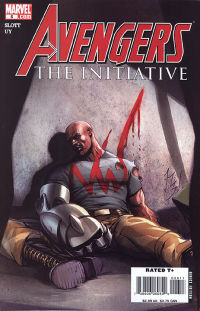 Speaking of Slott, he’s still sticking with Avengers: The Initiative, however. It’s been a great series so far, mostly because his characterization is so interesting, and the focus on different characters has worked well to expose different facets of the team. Issue 6 isn’t as strong as previous ones though, unfortunately.
Mostly, it’s just down to the fact that there’s a fill-in artist. Stefano Caselli’s art is such an integral part of the book - it’s balanced well between cartoony and realistic, and his action scenes are really punchy and impactful. It’s his facial expressions that are the real draw though. It adds a lot to the believability of the characters.
So, it’s pretty sorely missed, with Steve Uy stepping in for one issue - at least, I hope it’s only one issue. I’m pretty sure it is. Uy actually takes on all of the artistic duties for this issue, it seems. He’s not a bad artist, but his expressions lack subtlety, and he could do with having someone else ink his work, rather than doing it himself - it lacks a lot of definition, and often looks blurred. His colouring is pretty well suited though, with a flat pastel-dominated palette. His work would probably be overshadowed by anything stronger.
His layouts are the biggest problem, though. If it were more dynamic, his pedestrian art wouldn’t matter so much, but it’s just so flat, especially in comparison to Caselli’s layouts. It makes Slott’s scripting seem less interesting, as well, as it takes away a good deal of the impact that comes from Caselli’s expressive and dramatic work. Without spoiling it, this is a particular problem on the last page - it should have been more shocking and worrying than it is, but it’s just…plain. There’s nothing there that really has any feeling of weight.
And maybe it is just down to the art, but Slott’s story feels less focused than previous issues, and more meandering. It doesn’t feel like it’s furthering what’s been set-up previously, and it doesn’t feel like it delves particularly deeply into the personality of Gauntlet, the issue’s focal point. Hopefully the next issue will be back on track a little more, because it’s been a great book up until now.
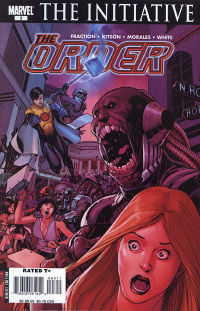 Matt Fraction’s The Order, on the other hand, remains as focused as ever. Marvel’s got some amazing writers working for them at the momen, and Fraction is right up there as one of the best. As with Slott and Nicieza’s work, it’s the grasp of character that Fraction clearly has that makes him such a pleasure to read, and there’s some brilliant characters in this book. In issue 3, the team face hordes of zombie hobos - or, zobos. It’s funny enough, but it’s not even really the focus; this is really based on character more than anything else, and the way each issue has zeroes in on a particular character while still being able to expand the roles and mannerisms of the supporting cast is masterful. Super hero comics don’t come much smarter than this.
It’s great seeing the team get more and more fleshed out as time goes on. James Wa, the feature of this issue, showed a little weakness last time around when he refused to kill cryogenically frozen Russian soldiers, but he’s built on marvellously in this issue, and shown to have some real hang-ups. Henry Hellrung, the team leader, is still probably the most interesting character, though - before receiving super powers from the government, he was an actor playing Iron Man on TV, and then a drunk, much like Iron Man himself. In fact, the first issue showed the two at AA meetings together in a flashback, which was a nice touch.
It’s Barry Kitson’s pencils that are the real key to the effective characters in the book, though. He’s got a knack of being able to draw slightly exaggerated figures that still look very much like real people, and the subtlety in his expression work is really top notch. So is his use of pauses in his layouts. Really great both dramatically and comically. It’s a really fascinating book, and it should be well worth sticking around to see where it goes in the future.
———————
I picked up a couple of CDs for review when I picked up the games from dB as well. Okay, maybe a couple is a little bit of an understatement - because I was sick last week, and was still trying to finish up a big pile from last time the week before I haven’t been in for about a month. Which meant that there were another 10 CDs sitting in my pigeon hole. That is, of course, cool with me, since I love the fact that I’m able to experience new stuff through dB like that. Let’s move through them quickly, and I’ll hopefully be able to write a little more about them as I review them over the next couple of weeks. Or maybe not.
 This is How I Hear Your Voice is the début EP for local Adelaide artist Zeal, and it’s a great piece of work. He’s got a cool style: sort of indie rock with beats, and his voice is pretty good too. If anything, it suffers a bit from the fact that Zeal is trying to explore so many facets of his music in just five tracks - there’s also a guest appearance from local MC Subsketch - but it’s definitely a promising start. Should be great to see where he goes from here.
Similarly cool and local is the début from The Brels: Parasites, Poptarts. Unlike Zeal, though, the guys in the band have been around for a while in other guises, so there’s a real sense of experience there. The album is pretty pure indie pop, and they have a great complexity and texture to their music. There are a few songs that aren’t quite up to the standards of the really great tracks - that is, there’s a couple of duds - but it’s a solid album, ultimately. They’re launching the album at the Jade Monkey in Adelaide next Saturday - the 6th - so that should be a really interesting night. They sound like they’d be a good live band.
Keeping things reasonably local still, former New Zealanders and current Melbournians Batrider have released their first album in Australia. And…Tara is probably the Australian album of the year at this point, as far as I’m concerned. Kid Cornered’s self-titled effort is a close second, but, honestly, I can’t get enough of Sarah Chadwick’s vocals. She’s furious, fearlessly emotive and screams like…I don’t know. Like Courtney Love being eaten by Nick Cave, who then regurgitates her into Kathleen Hanna’s mouth. Or something. Either way, it’s revelatory, and so filled with brilliant melodies and absolute passion that it’s impossible to ignore.
Perth…uh, what are people from Perth referred to as? Perthians? Perthicans? Erhm, nevermind. Point is, Jeff Strong is from Perth and plays some really interesting folky country, with a wicked sense of humour behind it all. Australian country can bepretty touch and go - I mean, hell, we’re responsible for unleashing the horror of Keith Urban on the world - but Strong manages to make music that is really Australian feeling without being cringe-worthy. His voice is initially a little jarring, but it’s really quite charming once you get used to it, and I think I really like it now. Especially on tracks like Eternal Darkness and Railroad. It’s a good album, all up, but it probably won’t get a lot of attention. Strong doesn’t seem to make it out of Perth much either, which is a pity, cause I’d love to see him live.
Science Fiction Illustrated, the second album from Glaswegians Mother and the Addicts is surprisingly good, given their crappy band name. There’s elements of !!!, Blondie, Gang of Four, but with a really Scottish air to it all. It’s very cool, and has about ten times more personality than anything by Franz Ferdinand. The début for Bumblebeez, Prince Umberto and the Sister of Ill, is also very cool. I haven’t listened to it terribly thoroughly yet, but I like what I’ve heard - kitchen sink indie electro. Nice. And who knew people from Canberra made music like that? I’m also yet to really get my head around The Weakerthans‘ Reunion Tour, but, again, I’m liking what I’ve heard of it.
I received a promo copy of The Scare’s debut Chivalry in the mail for an interview I did with their bass player the other day. I’m not a big radio listener, but I gather they’re getting quite a bit of airplay, which isn’t even close to a surprise - it’s seriously catch, very arch post-punk. They kind of remind me of Rocket Science, but with more focus on guitars, and a bigger drum sound. It’s really catchy, and really energetic: Ghetto Psalms in particular is an immediate classic. I’m looking forward to seeing them when they hit town on the 3rd of November.
I’ve also been listening to a bootleg of Bruce Springsteen live in 1978 that I found on the very cool Captain’s Dead blog (part one, and part two). I’ve not really heard a great deal of Springsteen - one of many artists that I just haven’t had a chance to get into - but this is a great gig, and well worth a listen. Pity the track listing is messed up, but maybe it’s fixed by now. Either way, it’s a real good show of why Springsteen has the reputation for great live shows that he does.
———————
Phew, well, that was a lot of writing. Hopefully next week won’t involve quite so much chatter from me - I’m probably going to be playing the same thing(s) and listening to the same albums, I’d wager. Nonetheless, be back here in a week for more of the Little Mathletics Shipping Report. I’m-a try my best to get this out every weekend. Let me know what you think.
Oh, and finally - go Cats! Geelong won an AFL premiership for the first time in 44 years, which is pretty amazing. As someone named after a former Cats champion, naturally this is a little bit exciting for me. I’m no football nut, but it’s hard not to be proud.
Hey, so maybe you’ve heard of this Denis Dyack fellow? Aside from his pretty awesome past with Silicon Knights on games like Blood Omen, Eternal Darkness and the upcoming Too Human, he’s received a lot of attention lately for his theories on how the industry should develop - and, most notably, preview - games. He’s outspoken, and certainly not afraid of what people think of his ideas, that’s for sure.
Whether you agree with him or not, it’s clear that he’s passionate about what he believes in, and, as anyone who knows me will attest, that’s something that resonates really strongly with me. And, as much as he can sound a little aggressive in quotes sometimes, Denis is a really nice guy.
I conducted this interview a few weeks ago at 6:30am, so the first few minutes were a little foggy, I must admit. Also, it was in the middle of the whole Game Developer Salary Report business, so I think I’d had about three hours sleep. Despite that, I think it turned out well; Denis has some interesting things to say about narrative, which is something that he does well that’s kind of being ignored right now, and then we talk about the obvious - so to speak - for a while.
Anyway, it’s worth a read. I’ll be doing a few more features in the next few weeks, including one that could be very special and might just coincide with a trip I’m making up to Sydney later in the week, but more on that as it happens.
Just a quick little note to let everyone know that I did indeed - after about an hour on the phone at the Target front desk - manage to get a new 360. Actually, that’s worth talking about a bit; the Microsoft employee spoke to the girl at the front desk, the store manager and me and consistently insisted that there was no way I could possibly have a new console. I would just have to take my broken one back home and send in the hard drive. After turning a shade of red somewhat similar to my t-shirt (according to an eyewitness account from my girlfriend) and asking, through grating teeth, no doubt, to speak to someone else, the Microsoft girl came back on the phone and asked if it would be okay if the store just gave me a new 360.
“Aaaagh.” I said. “Yes. That would be fine. That’s more or less what I’ve been trying to get at for the past hour.”
So, now I have a working 360. My gamertag is littlemaths. Add me and you too can experience the joy of making fun of my lack of Gears of War skill.
“Are you new at this, littlemaths?”
“Ummm…yes. That would be pretty accurate.”
(…in which our hero spends his hard earned money on an Xbox 360, runs into some trouble, makes a lot of phone calls, mournfully plays a game of Gears of War without being able to save his progress, takes some photos and finds disturbing pictures of dead presidents.)
Call me a little late to the party, but I’ve finally managed to get around to buying an Xbox 360. I’ve been planning on buying one for some time now - you know, as someone who writes for Official Xbox Magazine on a very regular basis, I thought it might be nice to actually own the damned machine. Plus, people keep offering me games to review. And I like free games.
So, when Target advertised a pack with Gears of War, Kameo and Project Gotham Racing 3 for only $50 more than the premium pack normally sells for, I thought it might actually be time to take the plunge. I’m a sucker for a perceived bargain, and the Elite SKU isn’t really doing that much for me, price-wise, so why not?
So, Thursday afternoon I headed down to the local store in the very heavy rain, handed over a lot of money - by my poverty stricken journalist standards - and then took the package home on the bus before gleefully plonking myself down crosslegged in front of the television to set the console up. After eventually finding a way to set up three consoles on a space of table roughly 20cm wide, I plugged the console in, and sat back to bathe in the experience.
“Looking good so far!” I thought to myself. “Sure, I don’t own the greatest TV in the world - and boy am I looking forward to buying a new one - but it looks pretty slick! Just give it a minute to load everything up…and another…and…hmm…”
“Uh…”
“Oh…”
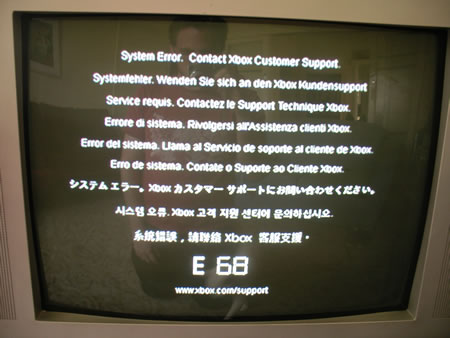
“Crap.”
“Well, at least it’s only one red light,” I mused. “That can’t be too bad. Maybe if I turn it off and on again…”
So I tried that, only to find that the same problem occurred, at which point I decided to actually follow the on-screen instructions and give Microsoft a call. The girl on the phone told me that, most likely, this was a problem with my hard drive, and taking it off would fix the issue - although, not the hard drive. I’d have to send that in, or take the whole console back to the store I bought it from.
I looked out the window at the torrential rain. “Hmmf,” I exclaimed sulkily. “I’ll send it back then.”
She gave me the details, and I silently grumbled about the seven day wait for a hard drive - and thus a seven day wait for game saves, Xbox Live, and even a Gamertag - and mopily played through the first level of Gears of War before realising I’d just have to do it again when I received a new hard drive, at which point I turned the console off and went to search for disturbing pictures to bother friends with over IM.
The next morning, I woke up and realised that sending the hard drive back was pretty damned counter-productive, and that I could fairly easily brave the bus with the console one more time, especially seeing as how the rain had more or less stopped. So, I picked up the phone and called Microsoft once again, and explained my situation. The good news, said the girl, was that I didn’t even have to bring in the whole console. Just the hard drive. “Huh!” I exclaimed in blank happiness.
I called up my local Target, and was told that they would have to check with the returns manager, but that it shouldn’t be a problem for me to just come in and swap the hard drive for a new one. Unfortunately, she was at lunch, but I’d receive a call from her as soon as she came back.
Three hours later, I decided to call them back myself, and asked to speak to the returns manager. “Speaking,” she replied.
“Ah,” I said. “I’m just calling regarding a return I need to make. I bought an Xbox 360 yesterday and the hard drive is corrupted. I’ve spoken to Microsoft, and they said that it shouldn’t be a problem to just come in and swap it for a new one.”
“Hmmm,” she said thoughtfully. “What’s a hard drive?”
“It…uh…” I was a little lost for words. I’ve always hoped not to be a technical elitist, but I couldn’t believe this woman was asking me this. “It’s…uh…a receptacle for data storage…” I stammered.
“What?” she said. “Is that the box?”
“Not the box, no. It clips on to the box.”
This went on for a little longer, before we came to some kind of understanding - I would just call the city store and deal with it that way, to save her from having to grasp any more difficult problems. Which I did, and spoke to a number of helpful people. I was on hold for some time, but it didn’t really matter; the problem was being resolved. Towards the end of one of the conversations, though, I was informed of some slightly bad news. The store didn’t have any hard drives in stock, and what was more, I couldn’t perform that kind of exchange at a store other than the one I bought it at.
“Fuck,” I said to the cat, who stared at me with some kind of pity, or possibly hunger, in his eyes.
In the end, the confused woman from the local store put me onto the guy in the electronics section that I had actually purchased the console from the day before. We laughed conspiratorially about the returns manager who didn’t know what a hard drive was. As it turned out, there isn’t actually any hard drives at this store either, but I can bring the whole console in, and, quite honestly, at this point I’m not really fussed. So, tomorrow morning, I’ll be jumping on the bus once again.
I’m keeping the batteries from the controller and the remote though.
Astonishing Post Only 15 Days Since The Last One
0 Comments Published by alistairw April 18th, 2007 in Website
I’m not a great blogger, really - I’m not totally sure what’s relevant to posting here. For example, today I had to go for a walk for an appointment, and ended up buying the second part of the second series on Twin Peaks on my way home. Then, just as I was leaving the store, I noticed they had Puyo Pop Fever for only $20, and decided to buy that too. I’m not sure that’s terribly important, but it did make for a pretty good morning. Currently, I’m eating some rather delicious mettwurst and listening to the new Joel Plaskett album, La De Da. It’s super hot alt.country. Actually, that’s more or less what this update is about - when I’m not getting paid to write about the world of video games, I’m doing freebie work for local music magazine DB, so I just thought I’d point out that I have five reviews in the latest issue, and you should all read them.
Firstly, there’s this one for the new Maximo Park album, Our Earthly Pleasures. It’s a good album, but not a great one. That single ‘Our Velocity’ is pretty amazing though, isn’t it? I’d probably hate it if it weren’t so goddamn catchy.
Next up is this one for the début album from Old Man River, an Australian group who I gather are pretty popular or something of that nature. I found the album to be entirely insincere, which is something that really irritates me. Anyone who reads my CD reviews on a regular basis - and I’m assuming there must be at least one person, even if it’s only the editor at DB - would probably notice that I have a bit of a thing for “raw” sounding recordings. Old Man River’s sound is a little too considered and plastic for me. On a similar note, the latest album for New Estate, Is It Real?, was a desperate attempt to sound like something that the band are not, which made the whole thing borderline unlistenable for me.
Much better was the newbie for Po’ Girl, Home to You, which was some pretty nice alt.folk with some excellent female vocals. It did veer off track here and there, but I should probably stop expecting every song on an album to be great - that never seems to happen all that much, really. Finally, and possibly most important to point out here, is the new album for New Zealand electro group Sola Rosa, Moves On, which is pretty excellent, with the exception of a few ill-advised tracks with vocals. Unfortunately, for some reason, the second half of the review got cut, so I thought I would post it here for the sake of completion:
“The album’s closer and title track is also well measured and restrained, though perhaps a little too much so, as its late night flute tinged funk leaves the listener actually wanting more; it could have gone well beyond its 5 minute track length without feeling bloated at all.
That’s the beauty of the Moves On in many ways, though – while many albums in the genre can seem initially appealing, only to drag by the end, Sola Rosa’s 45 minute effort is exceptionally well paced, as well as being wonderfully soulful and effortlessly cool.“
That’s pretty much all. I’m going to get back to work/Puyo Pop now.