The History of the Metroid Series
Published by alistairw August 22nd, 2006 in Articles
Here’s one more of these former-WiiEurope articles. This one is from late August 2006. Looking back, it’s funny how long these things actually took me to write, but I suppose there was a fair bit of effort put into them—I made an effort to understand the storylines and such, despite never having played Metroid Prime. Shocking, I know.
“As a last resort, the Federation Police has decided on this strategy: to send a space hunter to penetrate the center of the fortress and destroy the Mother Brain. The space hunter chosen for this mission is Samus Aran. He is the greatest of all the space hunters and has successfully completed numerous missions that everybody thought were absolutely impossible. He is a cyborg: his entire body has been surgically strengthened with robotics, giving him superpowers. Even the space pirates fear his space suit, which can absorb any enemy’s power. But his true form is shrouded in mystery.”
The instruction booklet to the first Metroid title set up an interesting mystery. The storyline was clear enough – a previously unknown species is discovered by Galactic Federation scientists on the planet SR388. Naming it “Metroid”, they begin a number of tests on the organism, and discover that it is able to drain the life energy from another being. However, the Metroids are stolen from the Galactic Federation by the Space Pirates, who return to the planet Zebes to replicate them. Faced with no other option, the Galactic Federation contact the bounty hunter Samus Aran, to ask for assistance in destroying the Space Pirates, their leaders, and the captured Metroids. But the question remained - who was the character that you were controlling?
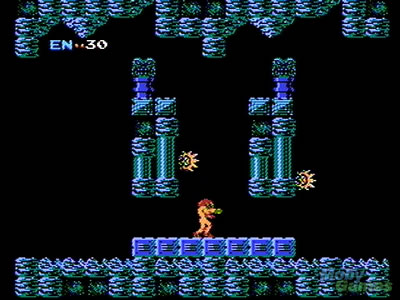
Of course, the mystery was solved shortly after the game’s August 6th 1986 Japanese, and August 1987 American release. Simply finishing the game would reveal who Samus Aran actually was – a female bounty hunter, which was certainly novel, if not groundbreaking. Up until that point, the vast majority of female characters in games had been “damsels in distress”, like Super Mario Bros.’ Princess Peach. Whether or not the instructions for the Western release were deliberately misleading is open to discussion, though. It’s quite possible that the references to Samus as a male were unintentional - a mistranslation of the gender neutral Japanese text, which is not an unreasonable assumption, given the lack of importance placed on translation in the 80s.
While any of the game’s endings would show brief glimpses of Samus, finishing the game within a certain amount of time would show her in different outfits and poses. Finishing the game in over 10 hours would show Samus with her suit on, facing away from the camera in disappointment, whereas finishing the game in under 5 hours would show her with helmet removed, waving at the camera. Finishing the game in under an hour would reveal Samus wearing nothing but a bikini, in all its 8-bit glory. This was a first in gaming - never before had there been any reward or incentive for a player to complete a game quickly other than bonus points.
Of course, finishing the game in under an hour was anything but easy, though it was possible, if you understood the game. Metroid presented the player with something completely different, at the time. Instead of the game being made up of side scrolling linear levels, like many other games of the time that had been inspired by Super Mario Bros., the planet Zebes is a sprawling world made up of various corridors and rooms. This allows for backtracking, but more importantly, it allows for sequence breaking, letting players – to some degree - obtain items in an order that they decide. The game contained platform elements, and much in the way of item collection and character upgrading. A good deal of the time, if you weren’t able to access an area straight away, it would be possible after collecting a new item. It’s something we take for granted these days, but the idea, which, like a lot of the game’s content came from producer Gunpei Yokoi, was a breakthrough in gameplay at the time.
Because of the sheer size of the game – 511 rooms – the game was originally released for
The game’s most famous password, JUSTIN BAILEY (followed by 12 spaces) left Samus wearing only a jumpsuit, which could normally only be seen by finishing the game in less than 3 hours. Contrary to popular belief, the password was not programmed into the game, but was actually a fluke. It happened to provide the correct parameters to trigger certain status changes, and also passed the game’s checksum function. There is only one password that has been proven to have been intentionally encoded into the ROM as a debug feature.
The password function was not the only change from the Disk System to the NES, though. The more recently released add-on system featured additional sound hardware, which meant that one channel of Hirokazu “Hip” Tanaka acclaimed soundtrack was not able to be ported to the NES.
The game sold over 2.7 million units, putting it in the top 20 NES games in terms of sales. Interestingly, the series has been considerably more successful outside of its native
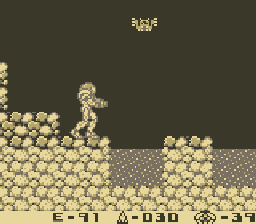
Metroid II: Return of Samus was released for the Game Boy on August 26th, 1991 in the
Unlike other titles in the series, though, the game is relatively linear. With the Space Pirate’s Zebes base considered destroyed, the Galactic Federation send Samus to eradicate the Metroids on their home planet: SR388. The advancement throughout the game is based more around the number of Metroids left in an area, rather than collecting items and defeating bosses – although both elements are still present, to a degree. Return of Samus introduced a good deal of information regarding the life cycle of the species – Samus fights Alpha, Gamma, Zeta, and Omega Metroids, before finally coming up against the colony’s Queen.
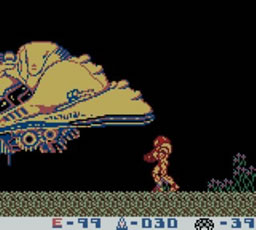
While initially well received, the title has aged less well than others in the series, and is considered the weakest of the games. It still managed to sell 1.7 million copies, however. After the release of the Game Boy Color, and the success of The Legend of Zelda: Link’s Awakening’s colourised re-release, a similar effort was planned for Return of Samus. Nintendo’s Dan Owsen even commented that the team behind the development of the handheld “were able to put a special ‘Metroid palette’ in the GBC hardware” in preparation for the re-release. However, despite pictures being made public at the time, the title never turned up.
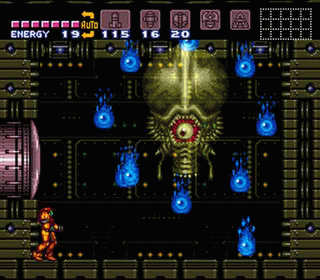
Super Metroid was released for
The story is set directly after the events of the second game, with Samus having returned from SR388 with a single Metroid larva. Leaving it with the Galactic Federation at the Ceres Space Colony, Samus heads off to hunt a new bounty, only to receive a distress call from Ceres shortly after. She returns to find that the Colony is under attack from Space Pirates, and loses the Metroid following a battle with the Space Pirate Ridley. Left with no other choice, she trails the Pirates back to their base on Zebes, which has since been rebuilt.
The game used the extra buttons of the SNES controller to expand the level of control the player had over Samus: her gun could now be angled diagonally, though the addition of a run button did irk a number of players. Graphically, the game made use of the SNES’ generous colour pallet to create a pervasive atmosphere, and its capabilities for generating large sprites to create some enormous and impressive bosses. Super Metroid also featured an exceptional soundtrack by Kenji Yamamoto and Minako Hamano - a number of the themes from which have been remixed and used in other Metroid titles.
Samus was conspicuously absent from the Nintendo 64, aside from an appearance in Super Smash Bros., and there was some speculation that the series would be retired due to its unimpressive Japanese sales. There was also some suggestion that the series had been retired, or at least, put on hold following the resignation of producer Gunpei Yokoi from Nintendo in 1996, and his tragic death in a car accident a year later.
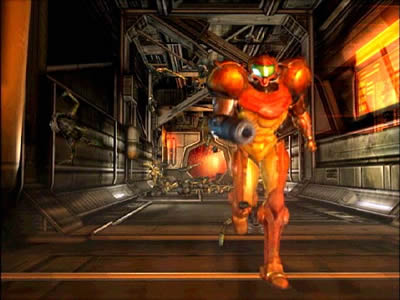
Eventually, Nintendo debuted ten seconds of footage from an upcoming GameCube Metroid title at their SpaceWorld event in 2000. With it came the revelation that the game was not being produced by Nintendo’s R&D1 team, like the rest of the titles, but rather by second-party Texan developers Retro Studios. At the following year’s E3, the company revealed that the title, now named Metroid Prime, would be a first person game.
The announcement was unpopular with many fans of the franchise. As much as people wanted a new Metroid game desperately, there was some fear that the series would be ruined by a development team unfamiliar who were yet to prove themselves, and who were apparently turning the game into a first person shooter. Unbeknownst the most at the time, the game was originally intended to a third person title, before Mario and Zelda creator Shigeru Miyamoto suggested the change in perspective. But the development of the game was far from smooth; Retro had to cancel all four of the other titles they were developing in order to focus on the project. The general consensus seemed to be that the company would ruin the game, and thus the series. Nintendo attempted to placate the angry fans by referring to the title as a “first person adventure”, rather than a first person shooter, but for many, Metroid Prime was already a write-off.
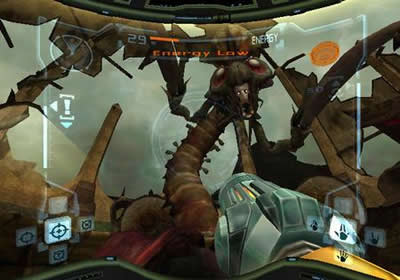
However, reaction was positive when the game came out in the
Fitting in between Metroid and Return of Samus, the title focused more on story than the series’ previous games. Metroid Prime gave Samus a more fleshed out, and somewhat less mysterious, back story, and implemented a style of continuous narrative throughout the title. The game is set on the planet Tallon IV, the home planet of the Chozo, a bird-like race that are revealed to have fostered the infant Samus Aran. The Elders of the race prophesised the destruction of their society by a meteor that would carry with it a mineral named Phazon, and the creature that fed on it, which they named “the Worm”. The Chozo civilisation was destroyed by the radioactive Phazon, but not before they had captured “the Worm”, which came to be known as the Metroid Prime.
Following Samus’ destruction of their base in the first game, the Space Pirates found traces of radiation, and discovered Tallon IV, and with it, the Metroid Prime. Samus aims to rid the planet of the Pirates, and unravel the mystery of the Chozo at the same time.
Oddly, there are a number of differences between the
The title eventually appeared as a pack-in game for the GameCube in 2004, and has currently sold over 2.7 million copies, making it the highest selling game of the series.
Around the time of Metroid Prime’s development, there was also talk of a Game Boy Advance title, rumoured to be Metroid IV; a direct sequel to Super Metroid. This was confirmed in early 2001, and the title, officially named Metroid Fusion, was shown at E3 in 2002. The game could not have been more different than Metroid Prime. As well as being a return to the 2D style of the SNES, Game Boy and NES titles, Fusion was developed by Nintendo of Japan second-party developer, Intelligent Systems, who are made up of many ex-R&D1 employees.
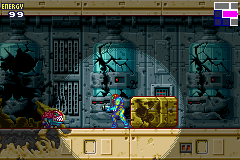
The game was released in the
After being attacked by an unknown organism on an observation mission to SR388, Samus is rendered comatose, and trapped within her suit. Thinking quickly, Galactic Federation surgeons remove the infected sections of her suit, and inject her with a vaccine prepared using Metroid DNA to stop the spread of the parasite, named “X”, within her own body. Samus ends up with a suit that is part machine, and part Metroid – thus the title. The infected sections of her suit are sent to Biologic Space Labs for further study, but soon after awakening, Samus is notified of a distress call: there has been an explosion in the same quarantine bay her suit was sent to.
While Fusion retains a lot of the gameplay elements from the SNES title, it also takes a lot of cues from the storytelling of Metroid Prime, and features cut scenes on a number of occasions. The game was well received, although the slight linearity of the game was criticised by some fans. To date, it has sold 1.5 million units.
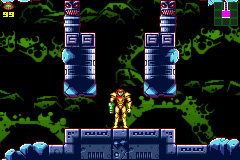
On the 9th of February, 2004, Metroid: Zero Mission was released for the Game Boy Advance in the
Because of this, the game differs from the original in a number of ways, and also adds a good deal of background to the story, such as the revelation that Samus was raised by the Chozo on Zebes. There are also a number of new items that did not appear in the first title and a few extra gameplay elements, like the Pirate’s ship above the planet, which is visited after what would have been the final battle. Nintendo have stated that the aim of the game was to “retell the story of Samus’ original mission” – though the NES game does feature as an unlockable bonus.
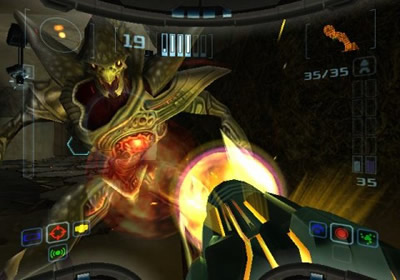
Just prior to the European release of Metroid Prime, Nintendo announced their intentions to produce a sequel. The game was titled Metroid Prime 2: Echoes at E3 2004, and received a November 2004 for both the
Echoes is set on Aether, another planet hit by a Phazon meteor. This caused the planet to divide into dark and light dimensions, and also attracted the attention of the Space Pirates, who raid the planet in an attempt to make up for the events of the first Prime game. Initially, the invasion is handled by Galactic Federation Marine Corps, but after contact with them is lost, Samus is dispatched to investigate. She finds that the Metroid Prime, which she thought destroyed, had actually mutated following its absorption of her Phazon suit in the game, and has become Dark Samus.
The title features an even greater focus on story than the first, and was exceptionally well received, aside from the multiplayer element, which was derided as “tacked-on” by many critics. To date, it has sold 1.1 million copies.
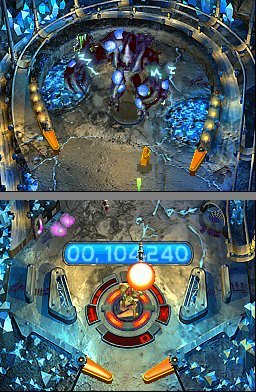
Metroid Prime Pinball for the Nintendo DS was released in Western regions in late 2005, though didn’t make it to
After being announced at E3 2004, a demo for Metroid Prime Hunters was released as a pack-in for the first shipment of the Nintendo DS. Titled Metroid Prime Hunters: First Hunt, the demo functioned more as a technical demo, showing what the system, and the American based first-party developer NST, were capable of. It’s also possible that the demo was used to garner fan reaction, and make changes to the full game accordingly.
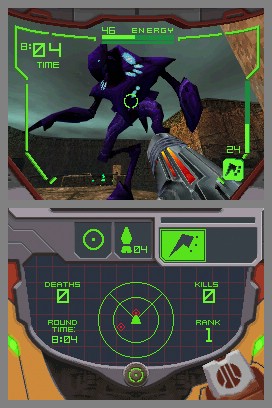
Hunters was delayed in late 2005, due to Nintendo’s decision to implement Wi-Fi multiplayer support. When it was finally released, on the 20th of March in the
The game marked the first chance for player to use characters other than Samus, though this was only possible in the multiplayer game. This section was extremely well received critically, with many praising the improvements made over other Nintendo Wi-Fi titles in terms of its usability. However, there was some criticism of the game’s single-player mode, which has been described as being overly “simplistic”. Hunters is intended to fit in between the stories of Prime and Prime 2, and tells of a utopian civilisation habited by a race called the Alimbics, who fell at the hands of a monstrous creature named Gorea.
Despite this, the game has proven popular, selling an estimated 800,000 copies, with almost 30% of users playing the game over the Wi-Fi connection.
Metroid Dread was announced in the June 2005 issue of Game Informer as a direct 2D DS sequel to Metroid Fusion. It has since been reported as cancelled no less than 3 times. In their March issue,
Metroid Prime 3: Corruption was officially announced for the Wii at E3 2006 – though it was assumed to be a sure thing after Nintendo had used a modified version of Echoes to demonstrate the first person possibilities of the Wii controller at the Tokyo Game Show the year before. It is confirmed as a release title for the system, and functions as a direct sequel to Echoes, and also completes the Prime trilogy. The story will involve a war of galactic proportions, with Dark Samus corrupting planets using Phazon seeds. Little more is known, other than the fact the game will see Samus teaming up with other bounty hunters.
Despite the series’ relative lack of popularity in
great review over the metroid series. i enjoyed reading it all and deffinently want to replay prime and prime 2 again. i’m also heavily awaiting the arrival of corruption