
shorthand for quality
August 13, 2008 by alistairw

Quiz Me Qwik: ‘Beer and Loathing With Matt Hestill’

['Quiz Me Quik' was a weekly GameSetWatch column, in which I picked offbeat subjects in the game business and interviewed them about their business, their perspective, and their unique view of life. This time - an enlightening chat with Matt Hestill.]

It’s been interesting reading Michael Walbridge’s series of interviews with prominent games journalists, and Simon Parkin’s recent column on the same subject. It’s really given me pause to think about some of the people I admire in the field; Michael is actually interviewing a number of them. There’s plenty of other people who I think exemplify the great things about games journalism – intelligence, an ability to think critically and a desire to move journalism past its occasional stagnancy in the mass-market commercial field. While a disappointing number of people writing about games are all too satisfied with towing a line of mediocrity, these people are pushing forward and asking, ‘Why can’t we expect more?’

Unfortunately, all of those people were too busy to talk with me, so I contacted my old acquaintance Matt Hestill instead.

You might know Matt from his blog, It’s Matt Hestill, Stupid - a surreal collection of self-obsessive rants and reviews, all written in Hestill’s somewhat underwhelming stream of consciousness style, punctuated with the odd bit of freeform poetry.

Or it was, anyway, until Hestill snapped in late January and deleted every single post because “the comments were just annoying and you people don’t deserve my insight into the games industry anymore so you can all just get fucked”.

“Hey Matt,” my initial email read. “I want to interview you for GSW, man. What have you been up to since you stopped the blog? Are you even still writing? Haven’t seen anything around lately. I thought you were meant to be doing some stuff for 1Up or something.”

“Wallis,” he replied. “Busy always. Here’s the interview’s focus: I am the next evolution of games journalism. The blog was my chrysalis. I was the pupa. Shutting the blog was the pumping of the hemolymph into my wings so that I might emerge stronger and more beautiful; flowering and rocketing. Now I am the butterfly, Wallis. Soon I will fly above the caterpillars of games journalism. Skype me.”

So, it quickly emerged that Matt had recently had something of an epiphany while rereading Kieron Gillen’s reknowned New Games Journalism manifesto. And then reading everything he could find on games journalism’s need for a Lester Bangs. And then reading Fear and Loathing in Las Vegas. And then, the following is what transpired, immediately after connecting to Hestill via Skype.

Read the rest of this entry »

  •   •   •   •   •
June 15, 2008 by alistairw

Quiz Me Qwik - ‘Talking To Myself’

['Quiz Me Quik' was a weekly GameSetWatch column, in which I picked offbeat subjects in the game business and interviewed them about their business, their perspective, and their unique view of life. This time, we get a little weird.]

This column seems to be turning into some kind of weirdly self-absorbed trip down memory lane for me, at least in the introductions, though it has on occasions made its way throughout the column proper like some kind of terrible beard-stroking, sky-gazing virus.

It’s like I’ve just discovered informal first-person journalism or something, except that I’ve been writing like this for other places for a while now.

Anyways, given the lack of angry comments calling me out on my egotism, I assume it’s not getting up anyone’s nose, which is lovely. And, on the odd chance that it is – and, by extension, I am - getting up your nose, hoo boy are you going to hate me this week.

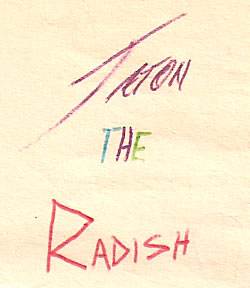
Back in early 1992, while in Mr Harris’ grade four class, I was engaged in some kind of cartooning cold war with my best friend Sam. I had created – amongst other things – a family of anthropomorphic radishes. He had created a family of anthropomorphic echidnas. And though we were best friends, we did have more than a few blow-ups: he copied me, you know? I like to think I was ahead of my time in regards to intellectual property protection rights.

Anyways, the one thing I had going that he didn’t was a video game design document. It was, admittedly, not a finished design document, but it was better than nothing. Unfortunately, I didn’t know the first thing about programming, and nor did any of my friends, so the Jaton the Radish game never really got underway – discounting a brief, unsatisfactory, jaunt into the world of Macromedia Director later that decade.

The documents, however, survive, and have been scanned for your enjoyment in an extraordinarily painful and time consuming manner: the scrapbook I used at the time is something like A3.75 or some inconvenient measurement. As such, the scanning was done in four sections for each page, before they were all stitched together. Goddamn it.

Back to the point at hand: since this column is called Quiz Me Qwik, and not - I don’t know; Show and Tell Hour or something, I’ve decided to interview myself about the project and its influences. Narcissism ahoy!

Read the rest of this entry »

  •   •   •   •   •
April 19, 2008 by alistairw

Quiz Me Qwik - ‘Being (Pranked By) Michael Trewartha’

['Quiz Me Quik' was a weekly GameSetWatch column, in which I picked offbeat subjects in the game business and interviewed them about their business, their perspective, and their unique view of life. This time... I went a little off the rails.]

I’ve become mildly fascinated with this little mystery lately. It’s a FAQ detailing the ‘programmers door’; an un-openable feature of the designers ending of Chrono Cross. According to the FAQ, there’s a lot of really weird things that can happen in that ending, if certain conditions are met. But, of course, it’s random whether or not they will be met, and so results may vary.

The overwhelming cynic in me suggests pretty much immediately that this is complete crap. It’s entertaining crap, at least, and seems to have enough basis on what really happens in the game to be believable for some people, but crap all the same.

But then, some people – especially younger gamers – will believe anything. I’m not talking about the EGM Sheng Long prank style stuff so much as simple playground stories. Things like the hidden level on the island above the Top Secret Area in Mario World; hidden characters in Wrath of the Black Manta, and so on. Stories that are products of a time when technology hadn’t quite caught up with the imaginations of nine year olds yet.

There are two examples that stand out for me. When I was younger, I only really had a 286 for games; we did have an Atari 2600, but it was pretty well broken by the end of 1988. Most of the games played on said 286 were “gifts” from a friend of my sister, and didn’t come with any documentation. Therefore, I had little idea of how to actually play them, and so when my friend Michael Trewartha told me in year four that he knew how to get further in two particular titles that had stumped me, I was all ears.

In a way, that’s something infinitely more insidious than April Fool’s jokes in magazines. That’s taking advantage of the trusting innocence of someone who doesn’t even know how to play the game. That’s not making up tales about how you found a secret ending for Double Dragon II which involves the evil clone end boss turning into a two headed dragon – it’s deliberately misleading someone looking for help in a basic sense.

And so, I tracked down Trewartha to ask about this gross displacement of trust, and to fish for an apology that should have occurred 16 odd years ago.

Read the rest of this entry »

  •   •   •   •   •
May 10, 2007 by alistairw

Playing Catch Up: Final Legacy’s Steve Englehart

['Playing Catch Up' was a weekly Gamastura column, in which I picked notable subjects in the game business and interviewed them about their career. This time - I had the chance to talk to the one and only Steve Englehart, writer of some of the best comics of the '70s.]

Today’s Playing Catch-Up, a weekly column that dares to speak to notable video game industry figures about their celebrated pasts and promising futures, speaks to Steve Englehart, co-designer of 8-bit Atari titles Final Legacy and E.T. Phone Home and writer of 2003 PC and Xbox title Tron 2.0.

Comic Beginnings

Englehart’s career began as a comic book writer. His first work was as an art assistant to Neal Adams on issue 10 of Vampirella in 1970, though he was soon drawn to working as a writer, and worked on popular and critically acclaimed runs of Incredible Hulk, Captain America and Avengers for Marvel, where he was known to fans as “Stainless” Steve.

A dispute with then editor-in-chief Gerry Conway over being forced to split Avengers 150 into two issues – and the fact that Conway added a number of pages of his own scripting to the latter - precipitated a move to rival publisher DC.

Over the course of the next year or so, he worked on Justice League of America and a celebrated eight issue run of Batman stories in Detective Comics before finally leaving the industry altogether, with, he says, the intention that he “wouldn’t be coming back”.

The Lure Of The Computer

His first novel, The Point Man, was printed by Dell Publishing in 1981, and Englehart was immediately asked to write a second, which he planned would focus on “the then-new and exotic place called the Silicon Valley”.

“That came to me because that was when I got into games, as a player,” he says. The area also happened to be just down the road Englehart’s home in Oakland, so Englehart called on a friend of his, Ted Richards, who had worked in underground comics like Dopin’ Dan while Englehart was at Marvel.

“Ted was working at Atari, and he was the only guy I knew in that field,” Englehart explains. “I asked him some questions about how the industry worked, and he said, ‘I don’t know the answer to any of that stuff, but come work for us’. I protested that I had a contract to write a novel. He said: ‘But we’ll give you a computer’.”

“So I returned my advance to Dell,” Englehart laughs, “in exchange for an Atari 800.”

The lure of the computer wasn’t the only factor, of course – Englehart explains that the possibility of a career in the industry proved too compelling and tantalizing an option to turn down. “I was fascinated by the computer and game industry, which was, again, just blowing up,” he comments. “I decided that there were lots of things I could do with my skills; that novels would still be there, etc.”

“The point, I guess, is that having an impressive background and unimpressive computer skills was the norm for those days,” he muses, “as we all helped shaped what the industry became. There were certainly people with great computer skills, but when the industry took off, the norm was more like me.”

Despite the change in industries, he comments that initially he felt “the only real difference was commuting to and from Milpitas every day and working in an office”.

“As a comics writer/novelist I had worked at home, by myself,” he says. “But a guy named Gary Fox also worked at Atari, in another division, and we shared the commute - he had an Alfa Romeo Spider convertible. And the guys in the office were a fun group. So the office life was different for me, though commonplace to most of the world.

Read the rest of this entry »

  •   •   •   •   •